
ISO 9001 · ISO 14001 · IATF 16949 · RoHS / REACH

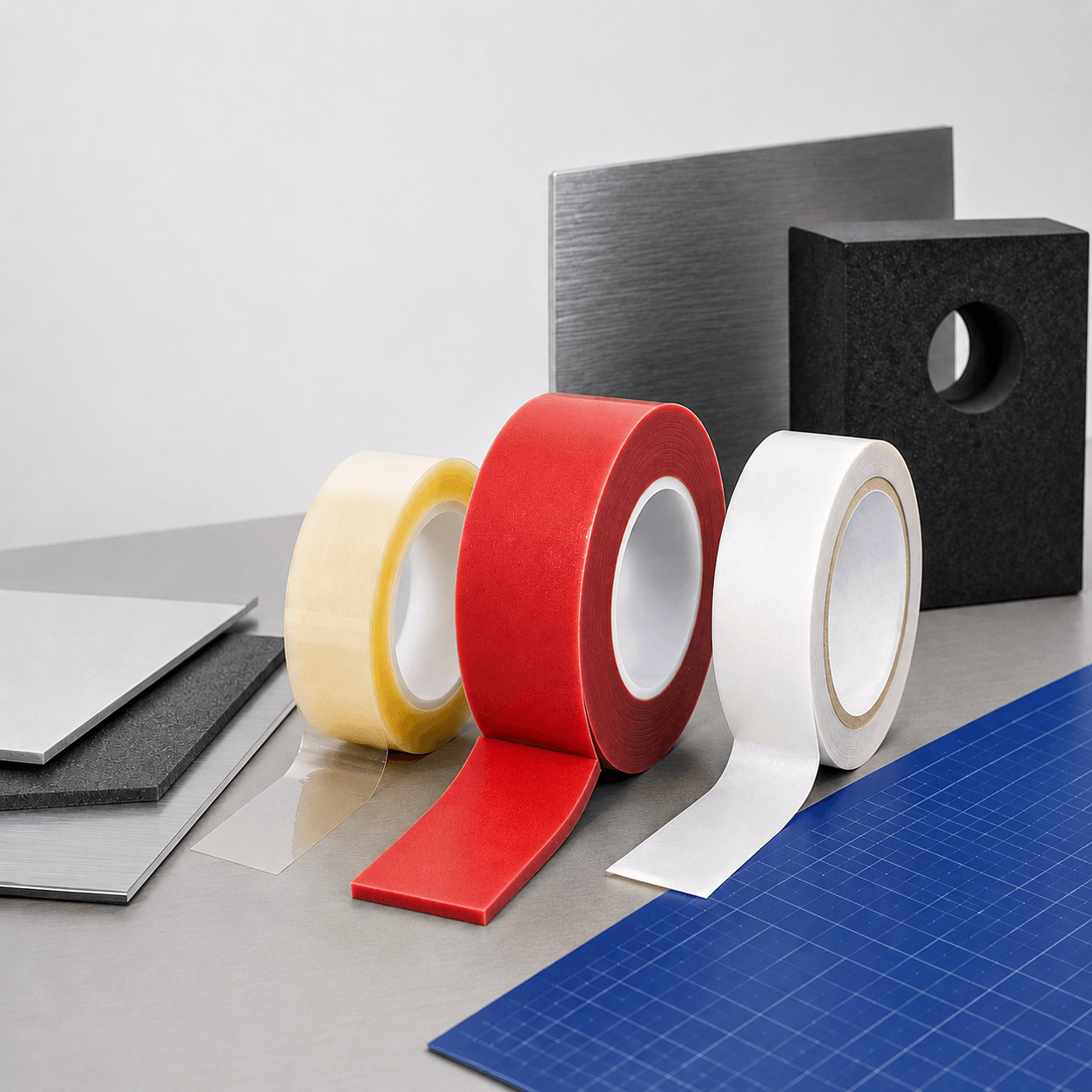
Most double-sided tape failures on industrial lines do not happen because the adhesive was “too weak” on a stainless-steel lab test. They happen because the carrier—the middle structural layer that supports both adhesive faces—did not match the surface flatness, the thermal expansion gap, the load direction or the die-cutting method.
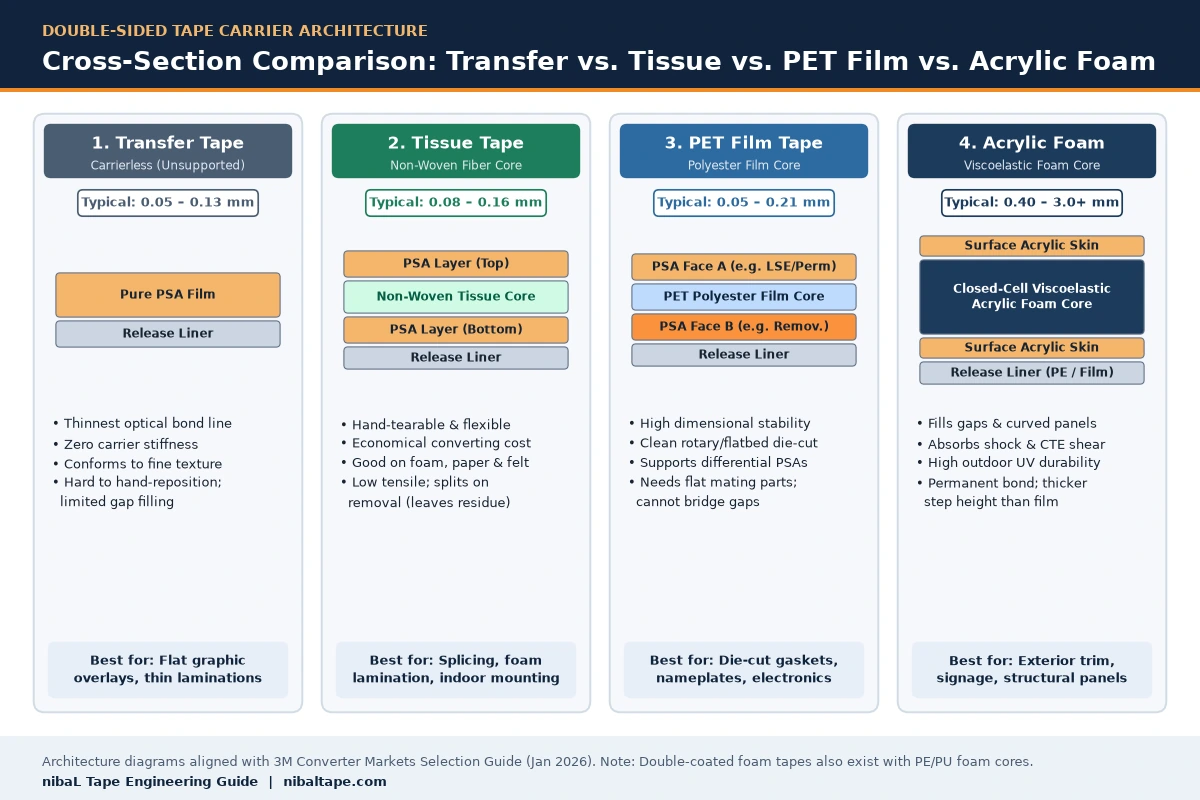
Before comparing peel numbers on a Technical Data Sheet, select the right carrier architecture first. In B2B assembly and converting, four constructions cover nearly every project: tissue (non-woven paper), PET (polyester) film, acrylic foam (high-bond viscoelastic foam) and carrierless adhesive transfer tape. This guide compares PET film vs. acrylic foam vs. tissue (plus transfer tape), explains gap-filling and CTE shear math, shows how load geometry changes “strongest tape” claims, and provides a copy-ready RFQ checklist.
Key takeaways
- Choose the carrier for mechanics, then the adhesive for environment: The carrier controls thickness, gap filling, dimensional stability during die-cutting, shock absorption and clean removability; the adhesive controls tack, UV durability and surface wetting.
- PET film wins precision and thin stack-ups (0.05–0.21 mm): Polyester film resists stretching on rotary presses, holds tight tolerances for custom gaskets and nameplates, and supports differential (permanent/removable or silicone/acrylic) constructions—but requires flat mating surfaces [R1] [R2].
- Acrylic foam for movement and surface variation. A conformable foam is worth sampling on a bowed or thermally moving part. Match the thickness and adhesive faces to the available space, contact area, finish and actual loads. [R2] [R3] [R6]
- Tissue (non-woven) wins hand-tearable economy and porous substrates (0.08–0.16 mm): Flexible non-woven carriers conform well to foam, felt, leather and corrugated board at lower material cost, but have low tensile strength and split when peeled away.
- Transfer tape is carrierless pure adhesive (0.05–0.13 mm): Ideal for the thinnest graphic overlays and flat laminations where zero backing stiffness is wanted, but harder to reposition by hand and unable to span gaps [R1].
Quick comparison: PET film vs. acrylic foam vs. tissue vs. transfer tape
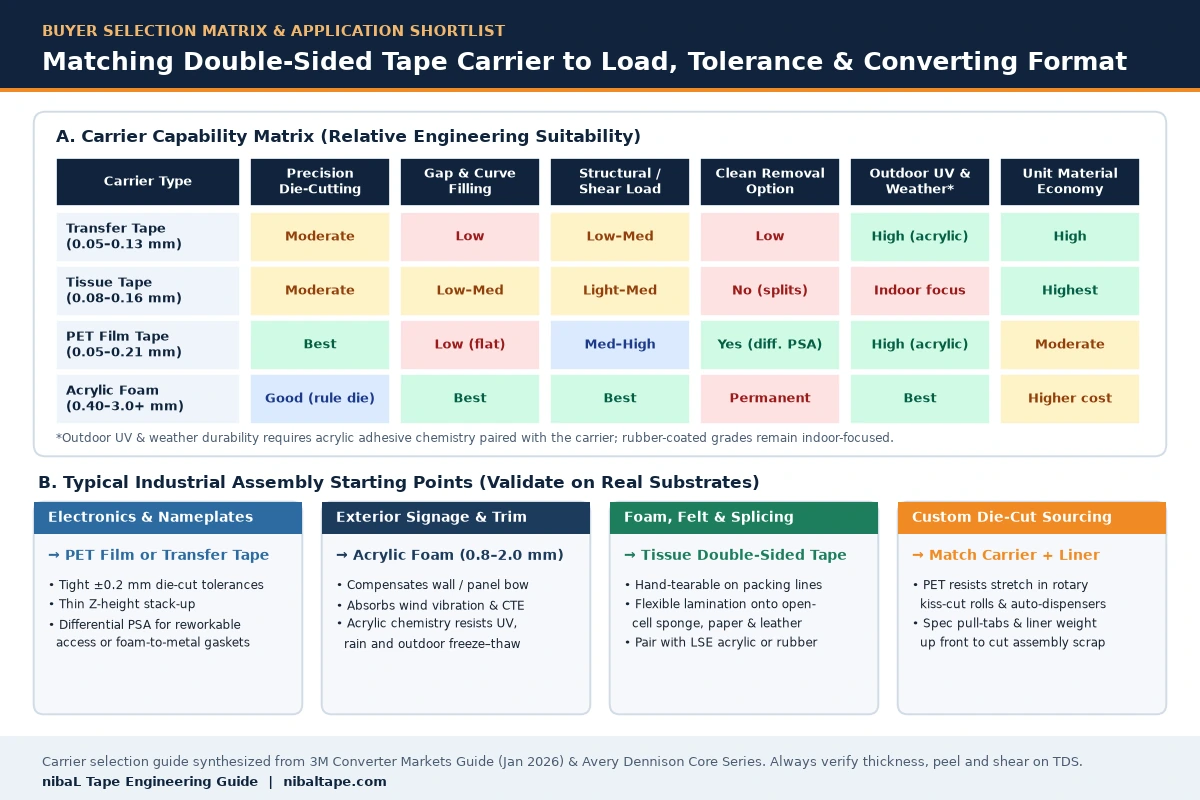
Use this side-by-side matrix to narrow your carrier shortlist before requesting sample rolls. Thickness ranges reflect common industrial constructions in 3M and Avery Dennison converter portfolios [R1] [R2].
| Construction | Typical Total Thickness | Gap & Curve Conformance | Die-Cutting Precision | Removability Option | Primary Industrial Fit |
|---|---|---|---|---|---|
| Adhesive Transfer Tape (no carrier) | 0.05–0.13 mm (2–5 mil) | Fine micro-texture only; cannot bridge macro gaps | Moderate (needs liner support; soft edges) | Low (no film to pull cleanly) | Membrane switch spacers, thin graphic overlays, flat metal/plastic laminating |
| Tissue / Non-Woven Tape | 0.08–0.16 mm | Flexible on soft/porous parts; limited macro gap fill | Moderate (fibrous edge; hand-tearable) | No — tissue splits and leaves residue | Foam/felt/sponge lamination, paper/film splicing, indoor light mounting |
| PET (Polyester) Film Tape | 0.05–0.21 mm | Low — needs flat, rigid mating surfaces | Highest (resists stretch & tearing) | Yes (with removable or differential PSA) | Die-cut gaskets, electronics bezels, nameplates, narrow strips, clear mounting |
| Acrylic Foam (High-Bond) Tape | 0.40–3.0+ mm | Highest — compresses into gaps & curves | Good (steel-rule or kiss-cut with stout liner) | Permanent structural bond | Exterior signage, architectural/appliance panels, automotive trim, dissimilar CTE joints |
Three starting points for trials. Screen PET or transfer tape for a thin, flat assembly. Compare a conformable foam grade where surfaces vary in flatness or move relative to one another. For hand-applied foam, felt or paper splices, trial a tissue carrier and check tear behavior on the line.
1. What a double-sided tape carrier actually does (and why transfer tape is different)
A standard double-coated tape consists of a central carrier film, non-woven web or foam core coated on both sides with pressure-sensitive adhesive and wound on a release liner [R1]. That center layer does four jobs that pure adhesive cannot do alone:
- Dimensional stability during converting and application: Keeps long strips and narrow die-cut frames from stretching out of tolerance while workers peel the liner or automatic heads dispense parts.
- Differential bonding capability: Because the carrier separates Face A from Face B, a manufacturer can coat two different chemistries—for example, permanent rubber or LSE acrylic on the foam-lamination side and clean-removable acrylic on the mounting side, or silicone PSA on one side and acrylic on the other [R2].
- Mechanical compliance and stress distribution: Thick foam cores deform microscopically to absorb peel shock, vibration and thermal expansion shear instead of concentrating force at the bond edge.
- Clean-removal backbone: When a temporary mounting tape must come off cleanly in one piece, a strong PET film carrier allows operators to pull the adhesive away intact without tearing.
By contrast, an adhesive transfer tape is an unsupported layer of pure PSA cast directly onto a release liner (or sandwiched between two liners for die-cutting) [R1]. Removing the carrier gives you the lowest possible stack height and seamless optical transparency, but removes tensile reinforcement—making transfer tape unsuitable wherever parts need repositioning, gap filling or clean one-piece removal.
2. Deep dive into each carrier: tissue, PET film, acrylic foam and PE/PU foam
Tissue (non-woven paper) double-sided tape
A tissue carrier is a thin, porous non-woven cellulose or fiber web saturated and coated on both faces with acrylic, modified acrylic or rubber adhesive. Its primary appeal is handling ease and converting economy: operators can tear strips by hand without knives or dispensers, and the soft fibrous core drapes easily around gentle contours, open-cell urethane sponges, felt, leather and corrugated packaging. Explore typical formats on our tissue double-sided tape page.
- Best uses: Roll-to-roll paper/film splicing, laminating acoustic or cushioning foams before die-cutting, print/packaging finishing, and economical indoor light mounting.
- Hard limits: Low tensile strength (will tear if pulled under heavy static load), poor moisture wicking resistance if unsealed edges sit in water, and impossible to remove cleanly—the tissue delaminates down the middle, leaving fiber and adhesive on both surfaces.
PET (polyester) film double-sided tape
When a drawing calls for thin total thickness (commonly 0.05–0.21 mm) combined with high tensile strength and crisp edges, PET polyester film is the default industrial carrier. Biaxially oriented polyester resists elongation during rotary die-cutting and high-speed liner peeling, maintaining tight dimensional accuracy for electronics bezels, speaker meshes, membrane switches, nameplates and narrow perimeter gaskets. For optically clear rigid bonding, see our clear double-sided tape range; for custom converted shapes, see custom die-cut double-sided pads.
- Best uses: Precision die-cut components (for tab geometry, kiss-cut roll formats and tolerance specs, see our custom die-cut adhesive pads design guide), differential permanent/removable assemblies, and high-temperature electronics mounting where PET holds shape well above 120–150 °C (short-term peaks higher depending on adhesive grade).
- Hard limits: Because polyester film is incompressible and thin, it cannot compensate for warped injection moldings, coarse cast surfaces or alignment gaps larger than a fraction of its adhesive coat weight.
Acrylic foam (high-bond viscoelastic) vs. standard PE / PU double-coated foam
Buyers frequently group all thick tapes together as “foam tape,” yet industrial engineering separates two very different constructions—both available under double-sided tape programs:
Key Structural Distinction: Viscoelastic Acrylic Foam vs. Double-Coated PE / PU Foam
Solid acrylic foam is viscoelastic—meaning it exhibits both viscous flow (wetting into micro-roughness) and elastic recovery (absorbing impact, wind vibration and thermal expansion shear) across its entire thickness [R2] [R3]. Unlike cellular PE/PU foams that can tear internally through the foam core under sustained shear or degrade outdoors, closed-cell acrylic foam acts as a unified structural damper—making it the benchmark for outdoor architectural signage, metal stiffeners, automotive exterior moldings and heavy appliance trim.
3. Gap filling, dissimilar thermal expansion (CTE) and load-direction strength
Two separate checks guide the shortlist. First, can the tape contact both surfaces across the measured bow? Second, how much will the parts try to move relative to one another as temperature changes? A passing peel value on a flat reference panel does not answer either question.
How load direction determines “double-sided tape strength”
A buyer asking for the “strongest double-sided tape” needs to specify how the load enters the joint. These four conditions call for different measurements. [R4] [R5] [R6]
- Static shear. A sustained load parallel to the bond line can produce creep. Compare holding power on a defined area and record temperature, load, time and slip. ASTM D3654 describes shear adhesion testing for pressure-sensitive tapes. [R5]
- Tension. A centered pull normal to the bond differs from an eccentric pull or an impact. Use the actual bracket geometry when the assembly experiences vibration, wind or repeated handling.
- Peel and cleavage. Peel progressively lifts a flexible member. ASTM D3330 measures peel adhesion under specified geometry. In cleavage, a relatively rigid part opens the joint from one edge. Use a representative assembly to evaluate that edge load, and report it separately from a peel result. [R4]
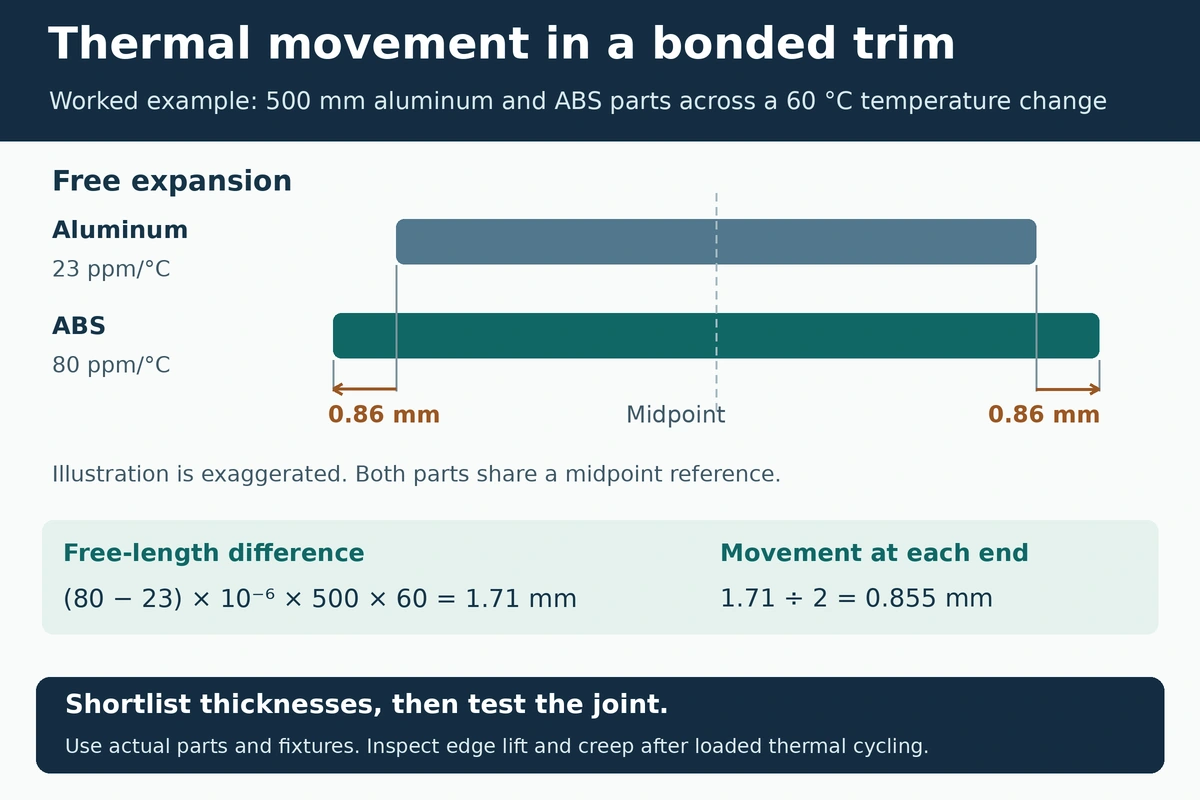
- Differential thermal expansion. For a 500 mm aluminum trim and ABS housing, assume expansion coefficients of 23 and 80 ppm/°C and a 60 °C change. The difference in free length is (80 − 23) × 10−6 × 500 × 60 = 1.71 mm. With a symmetric midpoint reference, each end moves 0.855 mm relative to the other part, or about 0.86 mm. A fixture locating one end gives a different distribution. Dividing 0.86 mm by a nominal 0.10 mm or 2.0 mm bond line gives an illustrative 860% or 43% displacement-to-thickness ratio. These ratios can flag a demanding geometry. They do not establish stress in any individual layer, service life or a pass/fail limit. Check the named grade’s movement guidance and trial the assembled parts. [R6]
4. Pairing carrier choice with adhesive chemistry and LSE substrates
Carrier selection and adhesive selection work as a matched pair. Choosing the right PET or foam carrier will still end in clean delamination if the adhesive cannot wet the substrate or survive the environment:
- High-surface-energy (HSE) metals, glass, PET, ABS and polycarbonate: Pure solvent or high-performance acrylic adhesives on PET film or acrylic foam provide peak shear, clarity and UV aging life [R1] [R3].
- Low-surface-energy (LSE) plastics (PP, PE, EVA, many powder coatings): Standard acrylic adhesives bead up on PP (29 mJ/m2) and PE (31 mJ/m2) [R1]. Specify an LSE-modified acrylic or rubber adhesive matched to your chosen carrier, and avoid assuming that any primer works automatically on every tape—read our detailed breakdown of acrylic vs. rubber vs. hot-melt adhesives and our step-by-step protocol on why tape won’t stick to PP or PE plastic.
- Release liner selection matters for assembly speed: Glassine paper liners work cleanly for flatbed sheets and light indoor tissue rolls; moisture-resistant PE-coated kraft or PET film liners prevent curling and tearing during humid shipping, automated dispensing and thick acrylic foam installation.
5. Worked assembly calculation, incoming QC checks and copy-ready RFQ
Consider a commercial refrigeration OEM running 12,000 cabinet units per year with two distinct double-sided tape joints on the same assembly line:
Joint 1: 500 mm Aluminum Exterior Trim on ABS Door Frame
Design inputs. The example spans 500 mm and cycles from −15 to +45 °C. Under the midpoint assumption this gives about 0.86 mm end movement. The molding also bows about 0.3 mm out of plane. Measure the contact pattern after assembly, and record where the hardware constrains movement.
Trial constructions. Request 1.6 mm and 2.0 mm acrylic foam samples at 19 mm width with adhesive faces suited to the two finishes. Use the same bond area, pressure and dwell for both. Compare edge lift, loaded creep and contact after the actual temperature cycle. Select the grade and thickness against the drawing tolerance and the assembly’s acceptance criteria. [R6]
Roll math (12,000 units × 2 strips × 0.50 m): Net demand = 12,000 m. At 33 m/roll, net = 363.6 rolls; adding 8% start/stop tail and rework allowance = 393 whole rolls, or 396 when ordered in full cartons (e.g., 33 cartons of 12 rolls).
Joint 2: Flat Polycarbonate Control Overlay on Painted Steel Bezel
Design check: Tight ±0.25 mm cutout window around an LED display; flat stamped metal bezel; minimum Z-height stack-up; zero foam shadow edge allowed.
Selected carrier + chemistry: 0.10 mm clear PET film double-sided tape (or 0.05–0.13 mm acrylic transfer tape) kiss-cut on a PET liner with an extended dry pull-tab.
Ordering format: Supplied as kiss-cut parts on rolls (or flat sheets) rather than slit tape rolls, cutting operator alignment time and window-cutout scrap.
Four incoming QC checks before approving bulk double-sided tape rolls
| Incoming Check | Reference Method | What to Measure on Trial Lots | Field Failure Prevented |
|---|---|---|---|
| 1. Total thickness & carrier caliper | Micrometer / gauge (liner-off check) | Verify tape thickness without liner against nominal tolerance across roll width | Prevents foam gap bridging failures or bezel stack-up interference |
| 2. Peel at 20 min & 72 h dwell | ASTM D3330 (90° or 180° peel) [R4] | Test actual production parts (not steel only); note clean adhesive peel vs. foam/tissue split | Exposes LSE wetting mismatch or mold-release contamination before launch |
| 3. Static shear & thermal cycling | Static holding power per ASTM D3654 [R5]. A separate assembly trial evaluates cycling. | Load the actual parts in their service orientation. Cycle between the specified minimum and maximum and record dwell times. Include the worst expected sustained load at temperature. | Record edge lift, displacement and failure location against the project’s limits. |
| 4. Liner release & die-cut matrix test | Bench strip-off / press trial | Check smooth liner peel without adhesive pick-off, edge ooze or tissue tearing | Prevents line slowdowns, stretched PET parts and scrapped die-cut sheets |
Copy-ready double-sided tape carrier RFQ template
Subject: Double-Sided Tape Specification & Trial Sample Request — [Project / Assembly Name]
- Substrate A & B (exact material & finish): [e.g., Brushed aluminum + Textured ABS / PP / Painted steel]
- Surface flatness & max gap: [Flat <0.1 mm / Curved or warped up to __ mm gap; panel span __ mm, midpoint or end restraint __]
- Target carrier & thickness: [Transfer / Tissue / PET film / Acrylic foam / PE foam; candidate thicknesses __ / __ mm]
- Load & service conditions: [Static shear __ g/cm²; indoor/outdoor UV; service load duration __ h, edge-lift and creep limits __, temp min __ °C to max __ °C]
- Removability / clarity / differential need: [Permanent / Removable 1 side / Optically clear / Silicone-acrylic]
- Delivery format & liner: [Slit rolls (__ mm × __ m) or Die-cut pads (attach DXF/PDF); paper or PET liner]
- Qualification & volume: [Trial roll/sheet count __; estimated annual usage __ m or __ pcs; RoHS/REACH/UL needs]
Frequently asked questions
What is the strongest double-sided tape?
Which failure sets the limit? A thin PET construction may fit a flat joint with tight clearance. A suitable foam may maintain contact on a bowed panel or accommodate some relative movement. Compare actual bond area, finish, temperature and load duration. For an edge-opening bracket, fixture the real geometry and watch for lift. For a hanging panel, measure creep under the design load. [R4] [R5] [R6]
Which double-sided tape works outdoors?
For exterior work, start with an outdoor-rated adhesive documented for the finish and UV exposure. A foam grade can be useful where surface contact or thermal movement drives the design. A thin exterior-rated PET or transfer tape may suit flat, well-matched parts. Confirm the grade on test assemblies after conditioning.
Is there a clean-removable double-sided tape?
Yes—choose a PET film carrier coated with a removable or repositionable adhesive on one side (a differential permanent/removable tape) or both sides [R2]. The strong polyester film lets you pull the tape off in one piece without tearing. By contrast, tissue tapes split on removal and solid acrylic foam tapes are engineered for permanent structural bonding.
What is the difference between double-sided tape and “mounting tape”?
“Mounting tape” is an application nickname that usually refers to a double-sided foam tape (either closed-cell acrylic foam or PE/PU foam). Because the foam core cushions weight and conforms to textured walls or slight gaps, distributors market it for mounting signs, trims and fixtures. Technically, mounting tape is a subset of double-sided tape rather than a separate product category.
When should I use transfer tape instead of double-sided PET tape?
Choose adhesive transfer tape when you need the thinnest possible bond line (0.05–0.13 mm), maximum optical clarity, or zero carrier stiffness on flat graphic overlays and flexible circuits. Choose double-sided PET tape when you need dimensional stability during rotary die-cutting, easier hand alignment without stretching, clean removability, or two different adhesive chemistries on opposite faces.
What about bonding low-surface-energy plastics like PP and PE?
Carrier choice alone will not fix poor wetting on polypropylene (PP) or polyethylene (PE). Pair your chosen carrier (tissue, PET or acrylic foam) with an LSE-formulated modified acrylic or rubber adhesive, and qualify 20-minute and 72-hour peel on actual production moldings before deciding whether a matched primer is necessary.
Technical Resources
- 3M — Converter Markets Selection Guide (January 2026 edition). Standard pressure-sensitive tape construction diagrams (transfer tape, double-coated film/tissue tape, foam core tapes) and substrate surface energy reference chart (mJ/m2).
- Avery Dennison Performance Tapes — Core Series Portfolio Product Selection Tool. Carrier and adhesive selection benchmarks including PET film, acrylic foam bond (AFB), differential permanent/removable constructions and substrate energy groups.
- 3M — Science of Adhesion: Common Chemistry of PSA Tapes. Technical explanation of functional acrylic foam cores for dynamic stress/vibration absorption and PSA bonding physics across acrylic, rubber and silicone systems.
- ASTM International — D3330/D3330M, Peel Adhesion of Pressure-Sensitive Tape. Current catalog edition D3330/D3330M-04(2025). Describes peel testing of pressure-sensitive tapes. Use a separate joint test for cleavage.
- ASTM International — ASTM D3654 / D3654M Standard Test Methods for Shear Adhesion of Pressure-Sensitive Tapes. Standard static holding-power methods for measuring shear endurance under constant parallel load (public summary reviewed).
- 3M — VHB Tape Design Guide. Page 8 discusses substrate, thickness, applied load and shear-plane movement for the VHB family. Use grade-specific guidance and verify candidate tapes on the assembly.
These references document industry testing standards and specific named manufacturers’ general construction principles. They do not imply brand endorsement, establish equivalence to a nibaL product, or replace qualification testing on your actual parts and applicable Technical Data Sheets.
ABOUT NIBAL TAPE
Specify the Right Double-Sided Tape Construction
nibaL Tape supplies and converts custom double-sided tapes across PET film, tissue and foam constructions, plus custom die-cut adhesive pads tailored to your liner and converting format. Learn more about nibaL.
Share both mating substrates, surface gap or panel span, temperature range, delivery format (slit rolls or die-cut parts) and estimated annual usage so our team can recommend matched constructions and prepare evaluation rolls or sheets.