
ISO 9001 · ISO 14001 · IATF 16949 · RoHS / REACH

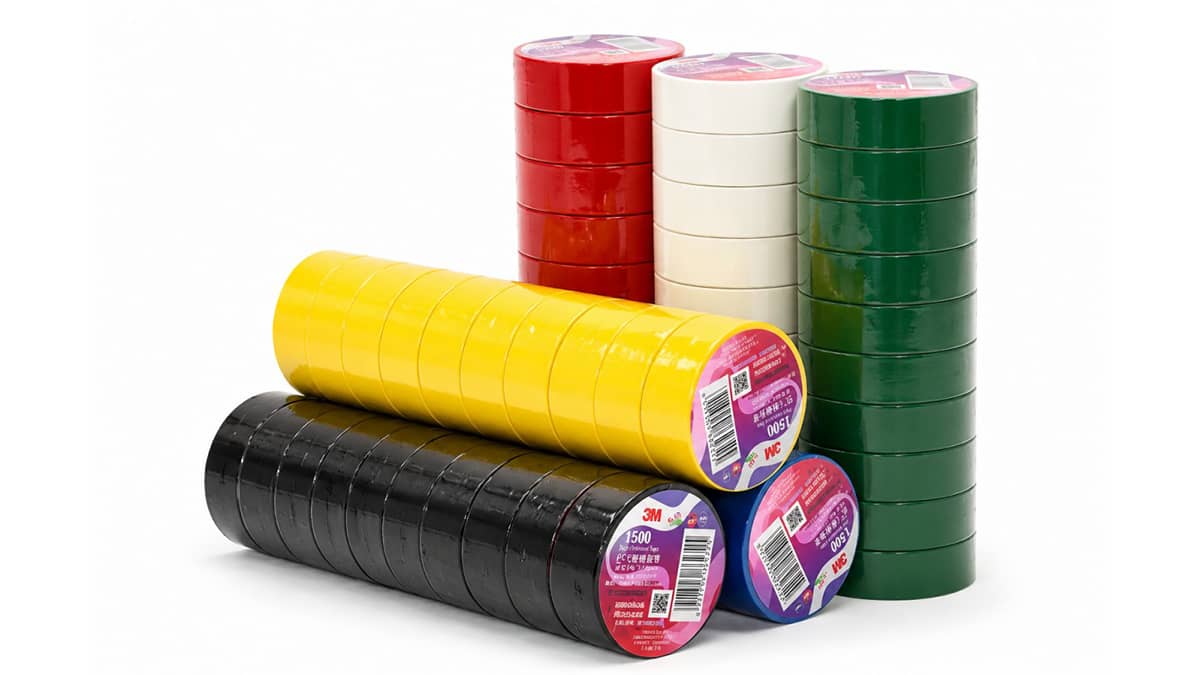
An electrical insulating tape has one job it cannot get wrong: maintaining safe dielectric isolation and mechanical protection across the temperature, moisture and handling conditions the splice will actually face. Choosing a PVC (vinyl) electrical tape by roll price or color alone misses the specifications that separate code-compliant insulation from tape that stiffens in winter, flags loose in a warm cabinet, or softens on a hot lead.
Before you order rolls for a panel shop, field service fleet or OEM wire harness, separate five engineering specifications on the Technical Data Sheet: actual agency listing (UL 510, CSA C22.2 No. 197, IEC 60454-3-1), standard-specific temperature range (not motor winding Class B/F/H labels), dielectric strength vs. rated working voltage, thickness and cold-weather elongation, and proper half-lap wrapping with a zero-tension final wrap. Where benchmark lab numbers appear below, they come from published manufacturer data sheets (such as 3M™ Scotch® Super 33+™ and 3M™ Temflex™ 165—cited strictly as documented technical benchmarks; Scotch and Temflex are trademarks of 3M Company and are not nibaL product names).
Key takeaways
- Read the working voltage from the listing. Scotch Super 33+ gives 600 V under UL 510 and 1,000 V under its CSA rating for the stated primary-insulation applications. Its ASTM D1000 dielectric strength describes a laboratory property of a sample. Use the listing and the splice-system instructions for the actual circuit. [1] [2]
- Do not confuse PVC tape ratings with motor winding Class B/F/H: standard PVC electrical tapes are rated around 80 °C (UL 510), 90 °C (IEC 60454) or up to 105 °C (CSA professional all-weather grades). Class B (130 °C), Class F (155 °C) and Class H (180 °C) belong to IEC 60085 / UL 1446 insulation systems using PET film, glass cloth or polyimide tapes—not plasticized PVC. [1] [5]
- Check minimum application temperature as closely as max heat: economy 6-mil vinyl tapes can turn brittle and lose tack near freezing, whereas cold-weather professional 7-mil grades stay pliable and maintain adhesion down to −18 °C (0 °F). [1] [2]
- Check the instructions for the chosen tape. For Super 33+, the manufacturer describes a half-lap and a final turn without tension to reduce flagging. The applicable splice system determines the assembly. [1]
- Verify color codes locally and check UV listing: US 120/208 V and 277/480 V phase colors differ from European IEC conventions and plant standards—never assume voltage from tape color alone, and confirm outdoor colored rolls carry UV and UL 510 ratings.
On this page
Quick selection guide by electrical application
| If your electrical job involves… | Tape construction to specify first | Key TDS check before approving rolls |
|---|---|---|
| Code-compliant indoor splices ≤ 600 V (UL) in mild room temperatures | UL 510 listed general-use PVC tape (typically 6–7 mil, flame-retardant, rubber PSA). [2] | Confirm active UL 510 listing (not just “meets UL” claims), 80 °C UL rating and zero flagging after wrapping. |
| Outdoor junction boxes, cold winter installs (< 0 °C) or direct sunlight exposure | Professional all-weather 7-mil (or 8.5-mil heavy-duty) PVC tape rated for cold and sunlight resistance. [1] | Verify UL 510 Sunlight & Cold Resistance pass, elongation at −18 °C (e.g., ≥ 125%) and CSA 105 °C upper rating. |
| A circuit above the tape’s primary-insulation rating, or a joint exposed to water or burial | Request a complete splice system rated for the cable, voltage class and installation environment. [1] [6] | Check the system part number, cable construction and environmental rating. Specify PVC as an outer protective wrap only where the manufacturer calls for it. |
| Three-phase busbar, conduit or motor-lead identification | UL 510 color-coding vinyl electrical tape (typically 7 mil, weather-resistant pigments). | Check UV fade resistance on outdoor colors and verify plant/local NEC or IEC phase color rules. |
| Motor windings, transformers, or continuous 130–180 °C engine/oven zones | Non-PVC high-temp insulation tape (PET polyester film, glass cloth or polyimide with acrylic/silicone adhesive). [5] | Do not substitute plasticized PVC above ~105 °C; verify IEC 60085 / UL 1446 system compatibility and varnish bake resistance. |
1. What PVC electrical tape is—and why 6-mil general vs. 7-mil pro grades behave differently
A PVC electrical tape pairs a flexible, plasticized polyvinyl chloride (PVC / vinyl) film backing with a non-corrosive pressure-sensitive adhesive (most commonly rubber-based for high tack and clean unwind onto its own backing). The plasticizer package lets the film stretch tightly around irregular splices, lugs and cable bundles, while flame-retardant additives allow listed grades to self-extinguish once an ignition source is removed.
Two rolls of black PVC tape can look identical on a warehouse shelf and still perform very differently in the field. Comparing two widely documented 3M reference grades tested to ASTM D1000 [4] illustrates why industrial buyers separate general-use from professional all-weather specifications (all values below are published 3M minimum/typical lab benchmarks for those named grades—not nibaL product guarantees):
| Specification (ASTM D1000 unless noted) | General-Use 6-mil PVC (Benchmark: 3M Temflex 165) [2] | Professional All-Weather 7-mil PVC (Benchmark: 3M Scotch Super 33+) [1] |
|---|---|---|
| Nominal thickness | 6 mils ± 0.6 (0.152 ± 0.015 mm) | 7 mils ± 0.7 (0.178 ± 0.018 mm) |
| UL 510 voltage & temperature | 600 V; −10 °C to 80 °C (14 °F to 176 °F) | 600 V; −10 °C to 80 °C (14 °F to 176 °F) |
| CSA C22.2 No. 197 rating | 1,000 V; −7 °C to 90 °C (19 °F to 194 °F) | 1,000 V; −18 °C to 105 °C (0 °F to 221 °F) |
| IEC 60454-3-1 classification | Type 5: 0 °C to 90 °C (32 °F to 194 °F) | Type 7: −18 °C to 90 °C (0 °F to 194 °F) |
| UL 510 Sunlight Resistance | Not listed for direct sunlight (indoor / weather-protected outdoor) | Pass (Flame Retardant, Sunlight & Cold Resistant) |
| Dielectric strength (min., std / high humidity) | 1,000 V/mil (39.4 kV/mm) / 90% of std. | 1,000 V/mil (39.4 kV/mm) / 90% of std. |
| Elongation at break (min.) | 200% at 23 °C | 225% at 23 °C; 125% at −18 °C |
| Adhesion to steel (minimum) | 18 oz/in (2.0 N/cm) at 23 °C | 20 oz/in (2.2 N/cm) at 23 °C · 30 oz/in (3.3 N/cm) at −18 °C |
| Adhesion to backing (minimum) | 18 oz/in (2.0 N/cm) at 23 °C | 18 oz/in (2.0 N/cm) at 23 °C · 30 oz/in (3.3 N/cm) at −18 °C |
When specifying custom widths, roll lengths, printed cores or multi-color sets for OEM harnesses or distribution, review nibaL’s PVC electrical tape product page for available supply configurations.
Worked example used across this guide: outdoor 480 V control cabinet & harness program
To connect voltage limits, temperature grades, half-lap geometry, phase coding and roll purchasing math across Sections 2 through 6, consider one illustrative OEM/MRO program (all quantities and dimensions are an illustrative worked example, not a nibaL quote or certified rating):
- Assembly: 500 industrial pump-control cabinets wired for 480 V three-phase service, installed outdoors in cold winter climates (maintenance down to −5 °C / 23 °F) and sun-warmed enclosures up to 75 °C.
- Purchasing scope. Each cabinet has six motor-lead joints. The buyer requests the approved joint system separately and budgets the black PVC used by that system. Phase-identification tape is a separate line item.
2. Dielectric strength, working voltage limits and what UL 510 / CSA / IEC actually verify
Purchasing specifications routinely mix up dielectric strength and voltage rating—an error that can create serious electrical safety hazards:
- Dielectric strength describes breakdown in a standardized test on a specimen. Both named data sheets give a minimum of 1,000 V/mil under standard conditions. Tape thickness multiplied by this value does not establish a working voltage for a joint. [1] [2]
- Working voltage comes from the applicable listing and the specified assembly. For Scotch Super 33+, 3M lists primary-insulation applications up to 600 V under UL and 1,000 V under CSA. Its other applications include exterior mechanical protection on specified splice systems. A higher-voltage cable requires a complete assembly matched to its voltage class, insulation, shielding where applicable, size and environment. [1] [6]
Circuit and cable
Record the system voltage, cable size, insulation type and shielding where applicable.
Installation environment
State whether the joint is indoors, exposed to weather, wet or directly buried. Request a system rated for that location.
Supplier documentation
Match the cable and conditions to a system part number and its instructions. Confirm the specified role of any PVC overwrap.
What “UL 510 Listed” actually requires: Under UL 510 (Standard for Polyvinyl Chloride, Polyethylene, and Rubber Insulating Tape), third-party listing evaluates flame retardancy (self-extinguishing burn behavior), dielectric breakdown before and after humidity conditioning, tensile strength, elongation, flagging resistance, storage deformation and—when marked—cold resistance and sunlight resistance. [3] For code-inspected work, always ask the supplier for an active UL File Number (Category OANZ for insulating tape) and verifiable marking on the core or packaging rather than vague “UL grade” wording.
3. Temperature ratings explained: PVC limits (80–105 °C) vs. winding Class B, F and H (130–180 °C)
One of the most widespread specification errors in electrical tape buying is confusing PVC vinyl electrical tape temperature ratings with motor and transformer insulation thermal classes (Class B, Class F and Class H).
Standard plasticized PVC film softens, creeps and loses plasticizer well below 130 °C. That is why even top-tier 7-mil professional PVC electrical tapes (such as the Scotch Super 33+ benchmark) carry a UL 510 upper limit of 80 °C (176 °F), an IEC 60454-3-1 thermal index of 90 °C (194 °F), and a CSA C22.2 No. 197 upper rating of 105 °C (221 °F). [1]
Class B (130 °C), Class F (155 °C) and Class H (180 °C) are thermal endurance designations in electrical insulation. A procurement specification should identify the evaluated material or complete insulation system and the applicable approval. The backing or adhesive name alone does not establish a class. For the separate question of adhesive selection, see our comparison of acrylic, rubber, hot-melt and silicone tape adhesives. [5]
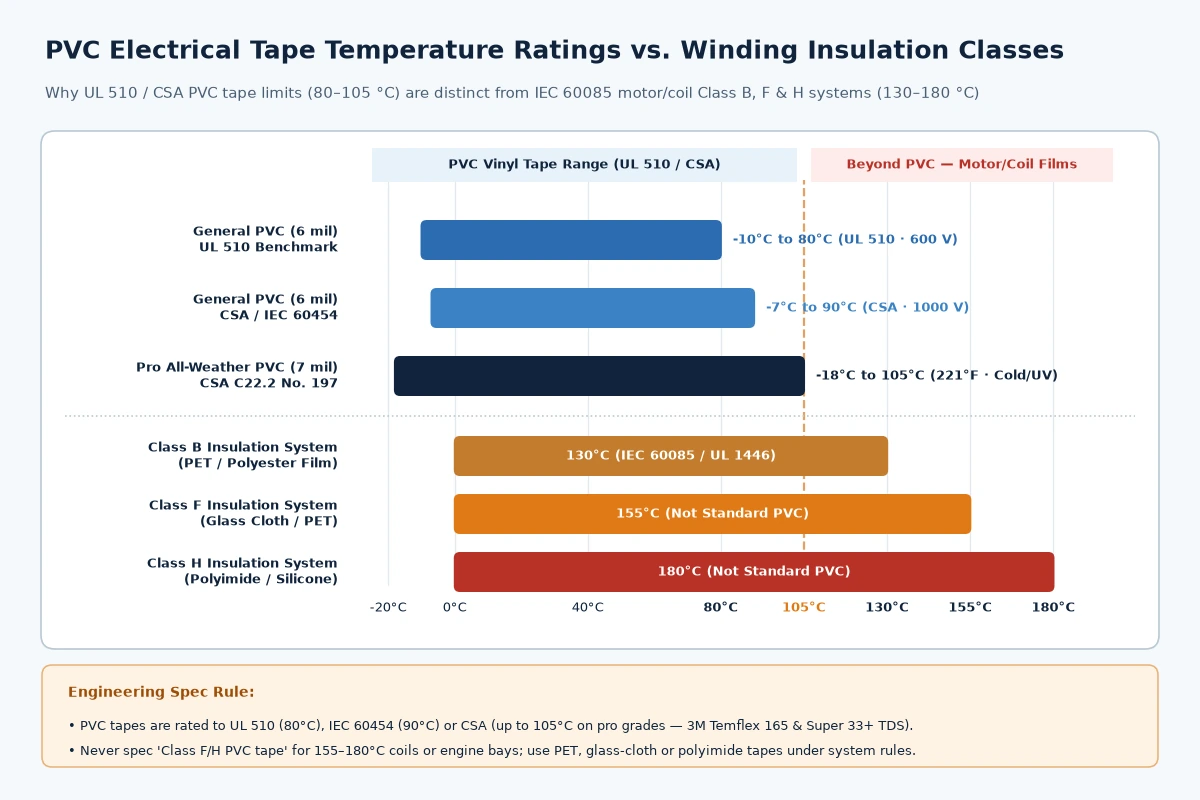
Applying Section 3 to our outdoor 480 V control cabinet: Because cabinet internals reach up to 75 °C and winter field servicing occurs at −5 °C, an economy 6-mil tape limited to 0 °C (IEC) or −7 °C (CSA) without sunlight resistance leaves almost no cold-weather or UV margin. Specifying a 7-mil all-weather UL 510 / CSA 105 °C cold- and sunlight-resistant PVC grade cleanly covers both −5 °C wrapping and 75 °C enclosure heat—without falsely requesting a “Class F PVC tape.”
4. Conformability, half-lap wrapping geometry and preventing end flagging
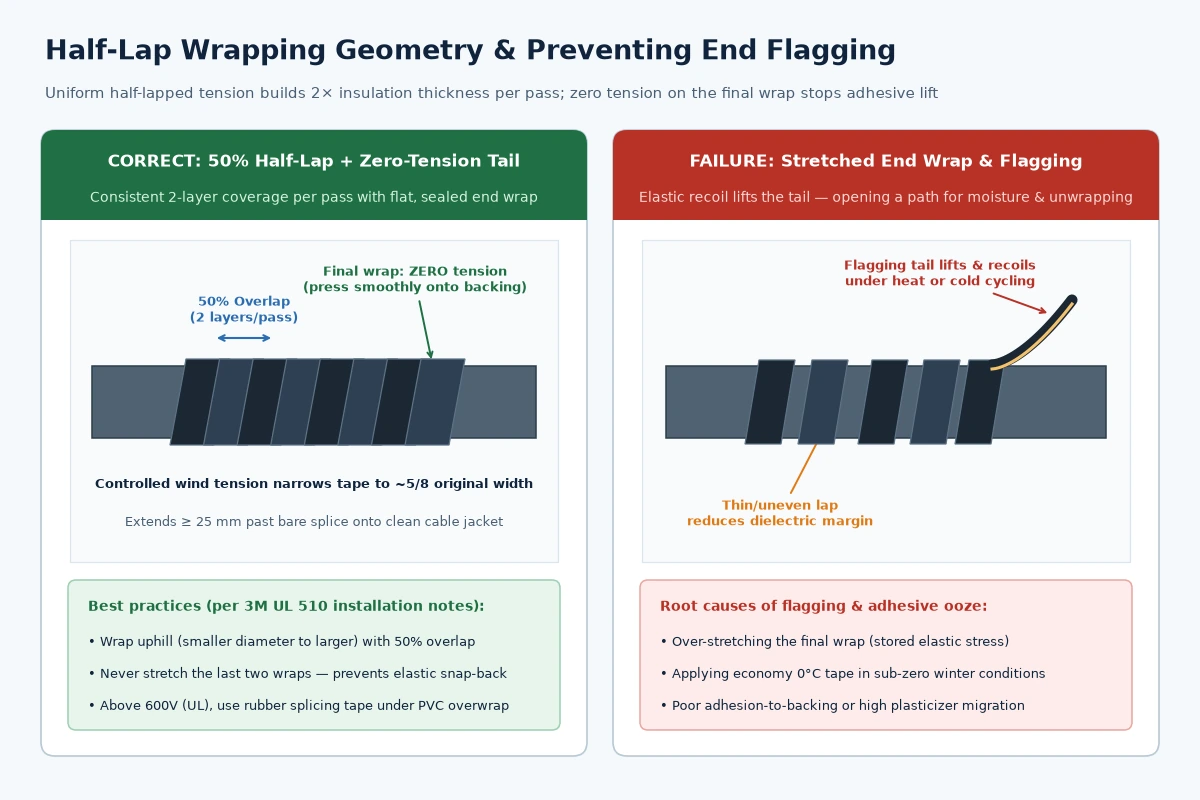
Flagging—when the outer tail of a wrapped electrical tape lifts, curls back and slowly unravels—is the single most common field complaint on PVC tape. It is caused by a combination of material elasticity (plasticizer stiffness, low adhesion-to-backing) and one repeatable operator mistake: stretching the final wrap tight before tearing or cutting it off.
For a purchasing trial, use the application instructions for the chosen tape and splice system. The following observations come from the Super 33+ data sheet and can help explain differences between trial rolls. [1]
- Overlap. The reference product calls for a half-lap. The effective band width on the part determines the advance per turn.
- Width under tension. For most applications covered by the Super 33+ instructions, 3M describes a working width around 5/8 of the original width. A nominal 19 mm strip would be roughly 12 mm wide under that particular condition. [1]
- Assembly geometry. A shoulder, connector or change in diameter can alter fit and tape consumption. Use the actual component and specified method when comparing two roll samples.
- Tail lift. For this reference tape, 3M calls for no tension on the final turn. Record edge lift and tail lift separately during sample evaluation. [1]
Storage check that prevents telescoping: Even a high-grade PVC roll will deform (“telescope” into a cone) or turn gummy if stored on a hot truck dashboard above 50 °C. Standard manufacturer storage guidance calls for cool, dry storage around 10–27 °C (50–80 °F) and < 75% relative humidity. [1]
5. Color coding (phasing), UV resistance and regional code cautions
Black PVC tape remains the workhorse for primary insulation and UV-resistant outdoor overwraps because carbon-black pigmentation naturally shields PVC from ultraviolet degradation. Colored PVC electrical tapes (red, blue, white, green, brown, orange, yellow, gray, violet) are used to identify circuit phases, feeders, grounded neutrals, equipment grounds and plant safety zones.
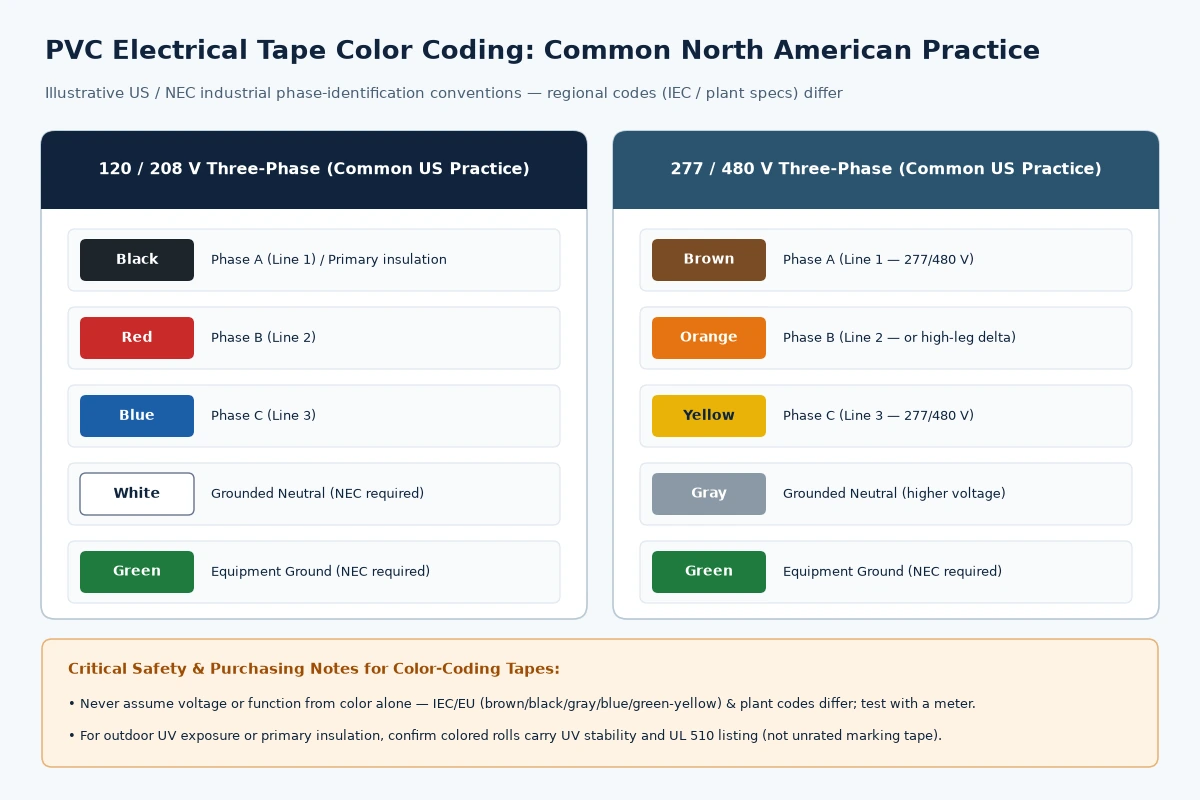
Two purchasing checks for colored electrical tapes:
- Code boundaries vary by jurisdiction: In the US National Electrical Code (NFPA 70), green (or green/yellow) is reserved for equipment grounding and white/gray for grounded neutral conductors, while ungrounded phase colors (black/red/blue for 120/208 V; brown/orange/yellow for 277/480 V) are widely followed industrial convention—except orange, which NEC specifically requires for the high-leg conductor on a 4-wire delta system. European IEC installations follow a completely different scheme (brown/black/gray phases, blue neutral, green-yellow protective earth). Never assume circuit function from tape color alone.
- Not all colored PVC tapes are UL 510 listed or UV-stable: Cheap colored vinyl marking tapes may lack flame-retardant UL 510 approval or fade outdoors within months. If colored tape is used outdoors or on live electrical terminations, specify UL 510 listed, UV- and weather-resistant 7-mil colored electrical tape (benchmarked by professional color-coding grades such as Scotch 35).
6. Roll-length purchasing math, incoming QC checks and copy-ready RFQ template
The useful purchasing unit is unwound metres consumed per approved joint. Roll width, part geometry and installer technique change the amount drawn from the roll. Record roll length, packaging and usable yield when comparing quotations.
Worked purchasing calculation: 500 outdoor 480 V control cabinets
For the illustrative outdoor cabinet order, budget 500 cabinets with six joints each, using 19 mm × 20 m black rolls. First measure a representative batch made to the chosen system instructions. Record how much tape left the roll and divide by the number of accepted joints. Track rework separately so the same waste is counted only once.
- Net joints. 500 cabinets × 6 joints = 3,000 joints. Let u be unstretched roll metres consumed per acceptable joint in the trial.
- Net metres. The estimate is 3,000 × u. As a sensitivity example, if the trial returns 1.50 m per joint, the order uses 4,500 m before allowance. If it returns 1.70 m, the corresponding input is 5,100 m.
- Whole rolls. At a planning allowance of 10% and 20 m per roll, the first case needs 248 rolls (4,500 × 1.10 ÷ 20 = 247.5, rounded up). The second needs 281 (5,100 × 1.10 ÷ 20 = 280.5, rounded up). Round to full cartons only after the supplier confirms rolls per carton.
Both unit-consumption figures are hypothetical. Finalize the black-roll order using measured consumption. Estimate each marking color separately from the project marking schedule.
Four fast incoming QC checks before releasing a production lot
| Incoming check | What to inspect on sample rolls | Red flag to hold shipment |
|---|---|---|
| 1. Thickness & roll geometry | Measure film + adhesive thickness with a micrometer (e.g., 7 mil ± 0.7) and check roll edges for telescoping or adhesive ooze. | Undersized film, coned rolls or sticky side edges that collect shop dust. |
| 2. Unwind & adhesion-to-backing | Unwind at normal hand speed; wrap a 16 mm mandrel half-lapped with a zero-tension tail and inspect after 24 hours warm conditioning. | Adhesive transfers onto the back of the film during unwind, or the end tail flags back > 2.5 mm. |
| 3. Cold-flex screen (for outdoor grades) | Chill sample rolls to your lowest field install temperature (e.g., −5 °C or −18 °C) for 2 hours, then wrap onto a chilled cable. | Film cracks, refuses to stretch smoothly, or loses tack immediately on cold jackets. |
| 4. Listing & compliance paperwork | Verify UL 510 / CSA file numbers, ASTM D1000 lot COA, RoHS/REACH declarations and core/carton markings match the PO. | Missing listing mark on core/packaging or unverifiable “UL equivalent” language. |
If your assembly also involves bonding wire-harness clips onto polypropylene (PP) or polyethylene (PE) enclosures—or requires die-cut insulating gaskets rather than wrapped rolls—see our PP and PE bonding troubleshooting guide and custom die-cut adhesive pad design guide.
Worked RFQ example and copy-ready template
“Please quote a trial lot of 10 black rolls and two rolls of each marking color on our approved schedule, in 19 mm × 20 m format. For budget comparison, quote black rolls at 248 and 281 rolls and state your carton pack. We will confirm the production quantity after the joint trial.
Application. The project uses outdoor 480 V three-phase pump cabinets, with field servicing down to −5 °C and enclosure temperatures up to 75 °C. Please identify the black tape grade, its listed uses and its role in the specified joint system. Provide the environmental rating for any proposed exterior wrap and colored marking rolls.
Required specifications: nominal 7-mil (0.178 mm) flame-retardant PVC film, rubber-based non-corrosive PSA, UL 510 Listed (with Sunlight and Cold Resistance rating) and CSA C22.2 No. 197 (or IEC 60454-3-1) where available. Please attach the grade TDS (ASTM D1000 data), UL file number, RoHS/REACH statement, shelf-life/storage terms, MOQ, carton pack and lead time.”
Copy-ready RFQ wording you can adapt
Please recommend candidates and quote [sample roll count] evaluation rolls and [order quantity] production rolls of PVC electrical tape in [width × roll length, e.g., 19 mm × 20 m] and [thickness, e.g., 6 mil / 7 mil / 8.5 mil]. Operating voltage is [voltage] in an [indoor / outdoor UV / cold-weather] environment from [min install °C] to [max service °C].
Required compliance: [UL 510 Listed / CSA C22.2 No. 197 / IEC 60454-3-1 / Flame-Retardant / Cold & Sunlight Resistant / RoHS-REACH]. Colors needed: [black and/or phase colors]. Please attach the current ASTM D1000 Technical Data Sheet, applicable listing file numbers, custom core/carton packaging options, MOQ and lead time.
Explore custom widths, colors and grades on nibaL’s PVC electrical tape page or send your electrical tape specification directly to nibaL to request evaluation samples.
Frequently asked questions
What voltage rating and dielectric strength do PVC electrical tapes have?
For example, Scotch Super 33+ lists primary-insulation applications up to 600 V under UL and 1,000 V under CSA. The same data sheet reports dielectric strength in V/mil for a laboratory specimen. For a higher-voltage circuit or a wet or buried location, specify a complete compatible splice system. An outer PVC tape has the protective role defined by that system. See Section 2. [1] [2] [6]
Do I need a UL 510 listed electrical tape?
For code-inspected electrical splices, panel building and commercial or industrial installations governed by NFPA 70 (NEC), yes—specify a verifiable UL 510 Listed (Category OANZ), flame-retardant insulating tape rather than unrated bundling vinyl. For non-electrical temporary bundling or wire pulling, unlisted general vinyl may be acceptable if flame-spread rules do not apply.
Can PVC electrical tape be used for Class F (155 °C) or Class H (180 °C) high-temperature jobs?
The named PVC reference grades carry their own product-specific ratings. Class F and Class H refer to thermal endurance at 155 °C and 180 °C respectively. Ask for the evaluated materials and insulation system for the winding and the applicable listing. See Section 3. [1] [5]
Why does PVC electrical tape unwrap or flag at the end—and how do I stop it?
First check whether the installer stretched the very last wrap before cutting it; elastic recovery pulls a stretched tail back up, especially during thermal cycling. Apply half-lapped tension through the body of the splice, then finish the final wrap with zero tension pressed flat onto the backing. If flagging persists, verify that the roll is rated for your installation temperature (e.g., all-weather cold-resistant PVC below 0 °C) and check adhesion-to-backing per Section 4. [1]
What do electrical tape colors mean, and can colored tape be used outdoors?
In common US industrial practice, black/red/blue identify 120/208 V phases, brown/orange/yellow identify 277/480 V phases, white or gray mark grounded neutrals, and green marks equipment ground—but codes vary by country (IEC differs significantly) and facility, so always verify with drawings and a meter. For outdoor phase marking, explicitly order UL 510 listed, UV- and weather-resistant colored vinyl tape so pigments do not chalk or lose adhesion in sunlight. See Section 5.
Technical Resources
- 3M — Data Sheet: Scotch® Super 33+™ Vinyl Electrical Tape. June 2022. Benchmark 7-mil professional all-weather PVC specs: UL 510 (600 V / 80 °C), CSA C22.2 No. 197 (1,000 V / 105 °C / −18 °C), IEC 60454-3-1 Type 7 (90 °C), ASTM D1000 dielectric/elongation values and half-lap zero-tension installation instructions.
- 3M — Data Sheet: 3M™ Temflex™ Vinyl Electrical Tape 165. Benchmark 6-mil general-use UL 510 / CSA / IEC 60454 Type 5 PVC tape properties, indoor/weather-protected scope and ASTM D1000 values.
- 3M — A Guide to Professional Grade Electrical Tapes. Overview of UL 510 deformation, storage, flame-retardant and cold/sunlight performance expectations.
- ASTM International — ASTM D1000 Standard Test Methods for Pressure-Sensitive Adhesive-Coated Tapes Used for Electrical and Electronic Applications. Public scope reference for electrical tape dielectric breakdown, adhesion, elongation and flagging test methods (public summary reviewed).
- IEC — IEC 60085:2007 Electrical Insulation: Thermal Evaluation and Designation. Official IEC publication establishing thermal classes (including Class B 130 °C, Class F 155 °C and Class H 180 °C) for electrical insulation materials and systems in motors and transformers, distinct from plasticized PVC vinyl tape temperature ratings (public summary reviewed).
- 3M — Industrial Quick Splice 5500 Series data sheet. Example of a complete medium-voltage splice specified for defined cable construction and voltage class.
These references document electrical testing standards and specific named manufacturers’ benchmark products. They do not imply brand endorsement, establish equivalence to a nibaL product, or replace verification against local electrical codes and applicable Technical Data Sheets.
ABOUT NIBAL TAPE
Discuss Your PVC Electrical Tape Specification
nibaL Tape supplies and converts custom PVC electrical tapes alongside double-sided tapes, hook-and-loop fasteners and die-cut adhesive pads. Learn more about nibaL.
Share your operating voltage, minimum install and maximum service temperatures, compliance requirements (UL 510 / CSA / IEC), colors, roll size and target quantities so we can prepare matched evaluation rolls.