
ISO 9001 · ISO 14001 · IATF 16949 · RoHS / REACH

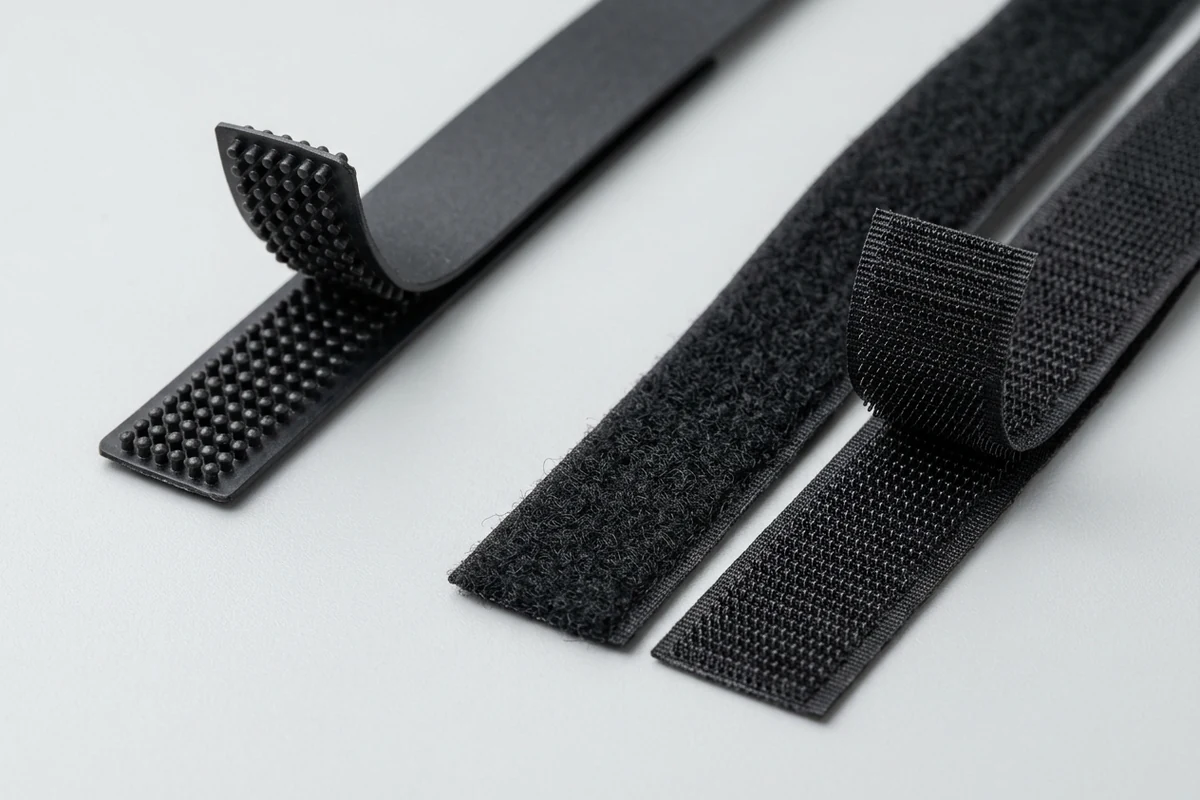
How often will a technician open the panel, and in which direction will the load pull on it? For a removable cover, compare the exact mushroom-head reclosable fastener and hook-and-loop tape pairings. In the published tests in Section 2, the 3M SJ3550CF Type 250/250 self-mating pair took more force to pull straight apart than the SJ3526N woven hook-and-loop combination, while their overlap shear values were close. A mushroom hook that mates with a textile loop is a different construction. Ask for data on that pairing before applying the comparison.
Before you swap one structure for the other, compare four real constraints on your assembly: load direction (tensile vs. shear), allowed gap thickness, expected lifetime opening cycles and how technicians will physically pry or peel the part open without lifting the adhesive backing. For OEM engineers and purchasing teams, this guide breaks down those trade-offs using published manufacturer reference data (such as 3M™ Dual Lock™ and 3M™ Scotchmate™ data sheets—cited solely as documented technical benchmarks; Dual Lock, Scotchmate and VELCRO® are trademarks of their respective owners and are not nibaL product names).
Key takeaways
- Separate three architectures first: self-mating polyolefin mushroom stems, molded mushroom hooks mated to textile loop, and traditional J-hook with woven loop behave differently in thickness, noise, cycle life and ordering math.
- Stronger in tension does not mean stronger everywhere: in published 23 °C lab benchmarks, a 250/250 interlocking mushroom pairing offers roughly four times the dynamic tensile disengagement of standard nylon hook and loop, yet virtually the same overlap shear strength and one-fifth the rated cycle life. [1] [4]
- Check engaged thickness before substituting: standard interlocking mushroom tape stacks to about 5.74 mm (226 mil) compared with roughly 3.6 mm (140 mil) for woven nylon hook and loop—enough to stop a flush panel from closing unless you redesign the recess or evaluate a ~2.5 mm low-profile stem series. [1] [3] [4]
- Respect stem-density and narrow-strip limits: avoid 170/170 (weak closure) and 400/400 (stem pull-out risk), and keep 250/250 strips at least 19 mm (0.75 in) wide so disengagement strength does not drop off. [1] [2]
- Oversizing mushroom area backfires: covering an entire perimeter multiplies engaged area, raises closing and opening effort and increases the risk of lifting the adhesive backing during servicing. Size corner pads from a load starting point and design a peel-open edge.
- Double-check single-SKU roll math: self-mating 250/250 reduces stock to one part number, but every mated joint consumes tape on both faces—so net order length is twice the single-side layout length, plus cutting waste.
On this page
Quick selection guide by assembly condition
| If your assembly requires… | Primary structure to evaluate first | Critical constraint to verify on samples |
|---|---|---|
| Rigid metal or composite panel under vibration or overhead tensile load (tens to a few hundred service openings) | Self-mating mushroom-head fastener (start at Type 250/250; step to 250/400 only if higher shear or tension is needed). [1] | Confirm ~5.7 mm stack clearance, representative snap-in force and safe pry-open access without lifting the PSA backing; add an independent mechanical safety tether wherever an overhead drop could create a hazard. |
| Frequent daily access (thousands of cycles), soft/flexible covers or curved contours | Woven nylon hook and loop (matched hook and loop grades rated for high cycle life). [4] | Verify the opening peel corner does not lift the adhesive backing and test loop fuzz/lint tolerance in the actual environment. |
| Tight enclosure gap (≤ 4.0 mm engaged stack height) | Standard hook and loop (~3.6 mm) or a low-profile mushroom-head series (~2.5 mm). [3] [4] | Check both lower temperature rating (70 °C) and lower rated cycle life (150 closures to 50% peel loss on SJ4570—for example, opening a cover 20 times/year over 10 years targets 200 closures, so request supplier test data at your actual temperature, substrate and cycle target). Never mix low-profile stems with standard stems. [1] [7] |
| Narrow flange or trim bezel (< 19 mm / 0.75 in wide) | Woven hook and loop, or widen local mounting bosses for mushroom pads. | Published 3M guidance warns against mating Type 250 strips narrower than 19 mm (0.75 in) to Type 250 because disengagement values can drop. [2] |
| Removable cover molded from polypropylene (PP) or polyethylene (PE) | Either closure architecture, strictly paired with an LSE-capable adhesive backing (never default acrylic). | Test the adhesive-to-PP interface first; a stiff mushroom snap transfers higher peel stress to the PP bond line during opening. |
1. Three fastener architectures buyers often confuse
In industrial purchasing, the phrase “mushroom-head fastener” gets applied to two completely different mechanical systems—and both are frequently grouped loosely alongside traditional hook and loop. Clarifying which of the three structures you are quoting prevents mismatched mating faces and surprises during first-article inspection:
| Architecture | Mating mechanism | Typical industrial role | Key limitation to watch |
|---|---|---|---|
| 1. Self-mating interlocking mushroom-stem (e.g., 3M™ Dual Lock™ class) | Rigid polyolefin stems with mushroom caps on both faces slide past each other and lock with an audible “snap.” [1] | Rigid access panels, transit interior trim, signage, vibration-prone enclosures replacing screws or clips. | Thicker standard stack (~5.7 mm), lower cycle rating (~1,000 cycles), higher snap-in and opening forces. |
| 2. Mushroom hook mated to textile loop (two-part A/B system) | Micro-molded or heat-formed mushroom-topped hooks on Side A grip a woven or knitted textile loop fabric on Side B. | Semi-rigid covers, seating cushions or heavy textile/trim mounts needing firmer hold than J-hooks without rigid dual-stem stiffness. | Still requires two distinct SKU faces (hook + loop); loop side can fray, collect lint or wear down faster under aggressive mushroom hooks. |
| 3. Traditional J-hook and woven loop (e.g., 3M™ Scotchmate™ / VELCRO® class) | Flexible J-shaped nylon or polyester hooks entangle randomly with soft textile loops under light pressure. | High-cycle inspection flaps, wire/cable management, curved or flexible covers, lightweight displays and soft goods. | Much lower perpendicular tensile holding; soft textile pile can creep or shift slightly under heavy vibration. |
The rest of this guide compares self-mating interlocking mushroom-head fasteners directly against traditional hook-and-loop fasteners, because that is the structural fork most OEM engineers face when evaluating screw-free panel mounting. When sourcing either option from a converter, see nibaL’s hook-and-loop and mushroom-head reclosable fastener page for custom slitting, die-cutting and adhesive-backing configurations.
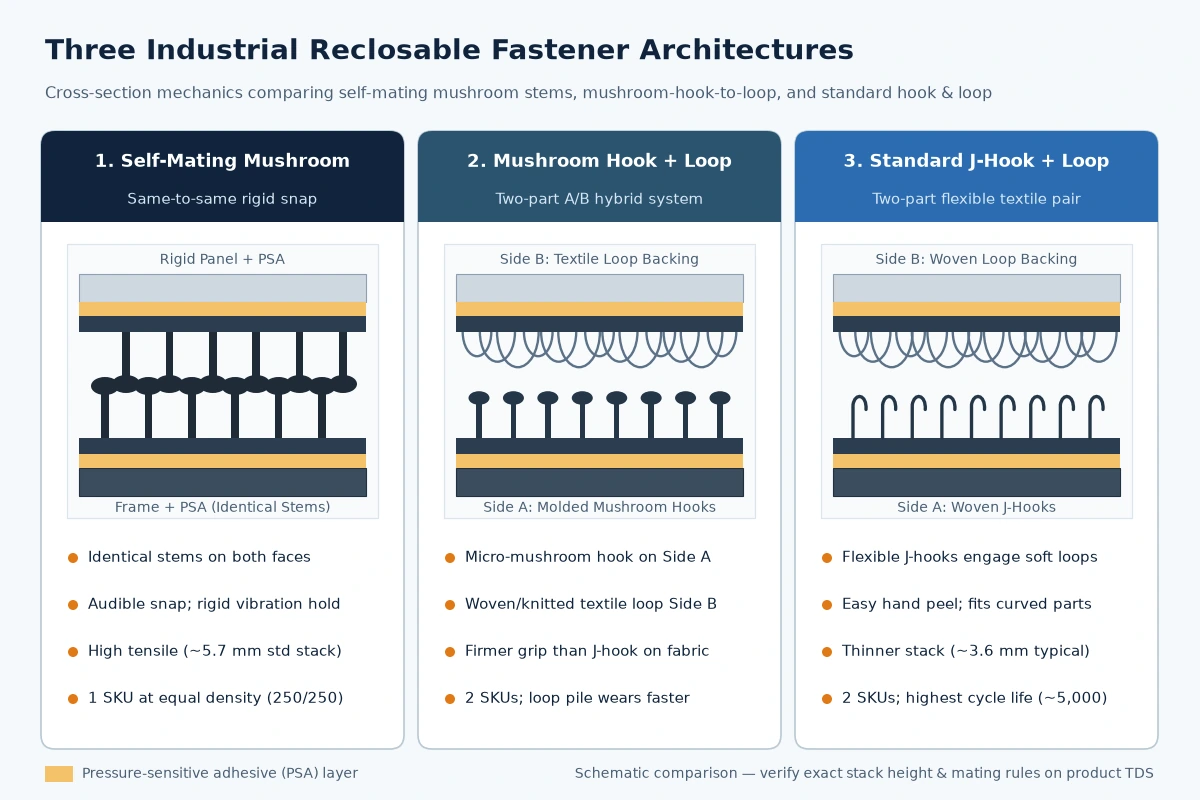
One quick compatibility check before moving on: engineers often ask whether you can press a self-mating mushroom strip directly onto an existing woven loop surface. While some rigid stems may snag loosely into fuzzy loop fabric, standard polyolefin mushroom fasteners are engineered to lock stem-to-stem—not against textile loops—and mixing the two gives unpredictable holding and rapid loop tearing. Unless a supplier explicitly qualifies a hybrid molded-hook/loop pair with test data, specify a matched system.
Worked example used across this guide: a removable aluminum service cover
To keep every thickness check, area estimate, opening-force warning and RFQ line grounded in real numbers, we will track one illustrative OEM assembly across Sections 2 through 7 (all dimensions, weights and order quantities are an illustrative worked example, not a nibaL performance claim or quote):
- Removable panel: 300 × 200 mm brushed anodized aluminum service cover weighing 1.2 kg (2.65 lb).
- Mating frame: powder-coated steel industrial control cabinet frame with continuous machine vibration.
- Service profile: hidden, screw-free attachment opened roughly 10 to 20 times per year for filter and electronics maintenance (well under 500 lifetime cycles), operating inside a warm plant room.
- Commercial scope: 500 cabinet sets for an initial production run.
2. Mechanical performance, engaged thickness and cycle life compared
Marketing summaries frequently compress the entire comparison into one slogan: “mushroom fasteners are 5× stronger than hook and loop.” That shorthand hides three critical engineering realities that only show up when you put published Technical Data Sheets side by side:
- The 4×–5× jump applies primarily to perpendicular dynamic tensile disengagement—not to every load axis.
- In pure overlap shear, a standard 250/250 mushroom pairing and woven nylon hook and loop test almost identically at room temperature (~15 N/cm² / 22 lb/in²); mushroom fasteners pull ahead in shear mainly when you step up to a 250/400 pairing (30–41 N/cm²). [1] [2] [4]
- Standard mushroom tape is roughly 60% thicker when engaged than woven nylon hook and loop—and carries one-fifth the rated open-close cycle life.
The benchmark table below compiles typical room-temperature (23 °C / 73 °F, 304 mm/min) laboratory values from four published 3M Technical Data Sheets and selection literature to illustrate how structure and adhesive backing interact. These numbers belong strictly to the named manufacturer grades under controlled lab conditions—they are not release specifications or nibaL product guarantees:
| Property (typical lab value) | Standard Mushroom 250/250 (3M SJ3550CF) [1] | Standard Mushroom 250/400 (3M SJ3550CF / SJ3560) [1] [2] | Low-Profile Mushroom (3M SJ4570) [3] [7] | Woven Nylon Hook & Loop (3M SJ3526N + Loop) [4] |
|---|---|---|---|---|
| Engaged thickness | 5.74 mm (226 mil) | 5.74 mm (226 mil) | 2.49 mm (98 mil) | 3.6 mm (140 mil) |
| Dynamic tensile (disengage) | 29.6 N/cm² (43 lb/in²) | 41.4 N/cm² (60 lb/in²) | 28 N/cm² (40 lb/in²) | 7.6 N/cm² (11 lb/in²) |
| Dynamic tensile (engage force) | 15.2 N/cm² (22 lb/in²) | 21.4 N/cm² (31 lb/in²) | 18.5 N/cm² (27 lb/in²) | Light hand pressure (no snap) |
| Overlap shear strength | 15 N/cm² (22 lb/in²) | 30 N/cm² (43.5 lb/in²) [SJ3550CF] 41 N/cm² (59 lb/in²) [SJ3560] | 28 N/cm² (41 lb/in²) | 15.2 N/cm² (22 lb/in²) |
| 90° peel / Cleavage | 4.0 N/cm (2.3 lb/in) peel; 21 N/cm (12 lb/in) cleavage | 8.4 N/cm (4.8 lb/in) peel; 53 N/cm (30 lb/in) cleavage | 2.9 N/cm (1.7 lb/in) peel; 7.1 N/cm (4 lb/in) cleavage | 3.9 N/cm* (2.2 lb/in) peel; 13.1 N/cm* (7.5 lb/in) cleavage |
| Cycle life (to 50% peel loss) | 1,000 closures | 1,000 closures | 150 closures | 5,000 closures |
| Long-term temp. resistance | 93 °C (200 °F) [SJ3550CF] 104 °C (220 °F) [SJ3560] | 93 °C–104 °C (acrylic PSA) | 70 °C (158 °F) [LSE acrylic] | 49 °C (120 °F) [rubber PSA; acrylic grades higher] |
*Metric peel and cleavage values for SJ3526N are converted directly from the published imperial values (2.2 lb/in and 7.5 lb/in width) for unit consistency. Note on cycle-life definitions: some product brochures summarize 1,000 closures as losing 50% of original tensile strength [3], whereas the September 2024 SJ3550CF and SJ3560 Technical Data Sheets explicitly define cycle life as closures before losing 50% of original peel strength [1] [2]. Always ask suppliers which metric, test method (such as ASTM D5169 for dynamic shear or ASTM D5170 for T-peel [5]) and statistical basis (integrated average vs. 5-peak average) backs their quoted number. For 3M SJ4570 (low-profile to low-profile), the published 150-closure reference uses the same 50% original peel-strength loss criterion [7]: if a buyer plans 20 openings per year over a 10-year service life (200 openings), 150 closures is a clear prompt to request candidate sample data at the actual temperature, substrate and cycle target (it is a defined lab test criterion, not a statement that failure occurs on cycle 151 or a nibaL lifespan claim).
Dust, lint and outdoor weather reality: In workshops, vehicles and outdoor cabinets, traditional woven loop surfaces trap lint, fibers and hair over time, gradually reducing hook engagement. Because polyolefin mushroom stems have no fuzzy fabric loops, they resist lint matting and can be wiped or rinsed clean. However, “outdoor” or “waterproof” durability depends primarily on the pressure-sensitive adhesive backing (closed-cell acrylic foam PSA plus proper degreasing and pressure) rather than the molded plastic stems alone.
Applying Section 2 to our 1.2 kg aluminum service cover
At 10–20 openings per year, our example cabinet cover would see 100–200 openings over ten years. For the 3M SJ3550CF Type 250/250 pairing, the published benchmark is 1,000 closures before peel strength drops to half its original value. Validate the chosen fastener on the actual panel at its service temperature and vibration level. [1] Meanwhile, continuous machine vibration and a warm plant room favor a rigid interlocking mushroom system with an acrylic PSA backing over a rubber-backed woven hook and loop (which tops out near 49 °C on rubber grades like SJ3526N and can shift slightly under vibration). The one immediate design check is cabinet bezel clearance: if the frame lip leaves less than 6 mm of standoff room, standard 5.74 mm mushroom tape will make the door sit proud unless the flange is recessed or a low-profile alternative is tested.
If your own assembly instead sees daily opening, lightweight flexible flaps or tight 3.5–4.0 mm clearances, traditional hook and loop is usually the smarter architecture—see our guide to choosing adhesive-backed hook and loop tape for pairing hook/loop grades, adhesive backings and opening corners.
3. Stem density pairing (170, 250, 400 and low profile) and narrow-strip limits
Unlike hook and loop—where closure force changes mostly with strip width and hook geometry—standard interlocking mushroom fasteners let engineers tune engagement and release force by mixing three stem densities: Type 170 (~26 stems/cm²), Type 250 (~39 stems/cm²) and Type 400 (~62 stems/cm²). [1]
| Mating combination | Relative closure tier | SKU count | Engineering guidance |
|---|---|---|---|
| 170 to 170 | Not recommended | — | Too few interlocking stems for a reliable mechanical lock. [1] |
| 170 to 250 | Low / easier opening | 2 SKUs | Useful on thin or delicate panels where technicians must open the cover easily without prying hard. |
| 250 to 250 (or 170 to 400) | Medium / standard baseline | 1 SKU (250/250) 2 SKUs (170/400) | Recommended evaluation starting point; 250/250 simplifies inventory because both sides come from one roll. [1] [3] |
| 250 to 400 | High strength | 2 SKUs | Steps up overlap shear and tensile holding substantially, but requires higher snap-in pressure and firmer opening leverage. |
| 400 to 400 | Not recommended | — | Excessively tight engagement; opening can tear stems and mushroom heads out, destroying reclosability. [1] |
| Low Profile (~705 to ~705) | Slim self-mating only | 1 SKU | Mates only to itself; never intended to mate to standard 170, 250 or 400 strips. [1] |
Two layout rules engineers miss: minimum width and alignment tolerance
- Minimum width red line for 250/250: Published 3M SJ3560 design guidance specifically notes that Type 250 strips narrower than 19 mm (0.75 in) should not be engaged to another Type 250 strip because low disengagement values may occur. [2] If a thin bezel leaves only 10–12 mm of bonding land, either add local corner tabs widened to ≥ 25 mm or evaluate woven hook and loop instead.
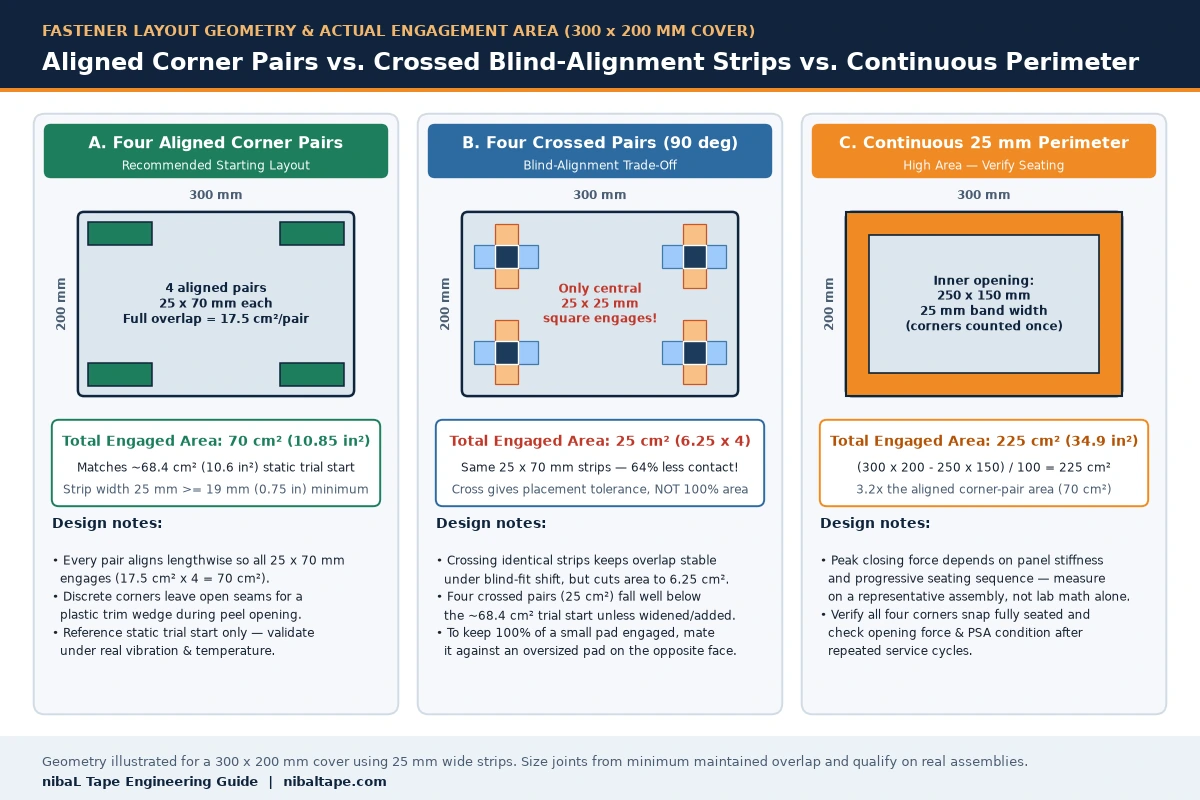
- Absorbing blind-alignment tolerances: Published 3M SJ3560 design guidance lists two distinct alignment geometries: (a) making one mating pad larger than the other so the smaller pad stays fully engaged across small offsets, or (b) crossing two strips at right angles. [2] Count their engaged areas separately: two 25 × 70 mm strips provide 17.5 cm² of engagement when fully aligned. Cross the same strips at right angles and only the central 25 × 25 mm square engages (6.25 cm²)—so four crossed pairs deliver only 25 cm², well below the ~68.4 cm² static starting area calculated in Section 4. The cross tolerates small placement shifts while that square stays inside both strips. Size the joint using the overlap you can maintain at the worst allowed offset.
4. Why “stronger” can fail: area sizing, engagement force and panel opening
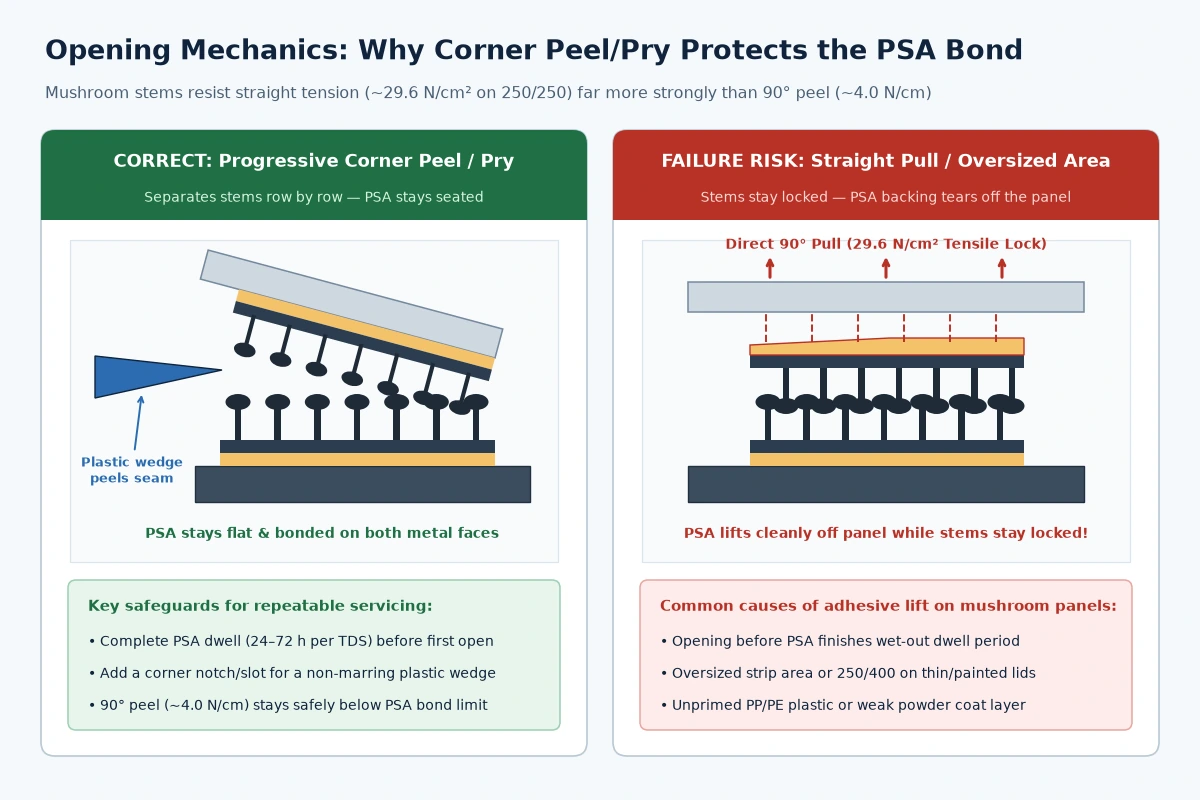
During a service opening, the cover can bend or the adhesive backing can lift before the fastener separates. Give the technician an accessible opening corner and check on the actual panel whether the closure releases while both adhesive strips stay seated.
That happens because a reclosable assembly has three interfaces in series: Side A adhesive to panel, interlocking stems in the middle, and Side B adhesive to frame. If you pack too much stem area onto a cover—or try to yank the cover straight off perpendicular to the frame—the stem lock can exceed the peel strength of the pressure-sensitive adhesive or the flexural stiffness of a thin cover.
Worked calculation: sizing corner pads and checking snap-in force for the 1.2 kg cover
Return to our illustrative 300 × 200 mm, 1.2 kg (2.65 lb) anodized aluminum service cover mounted vertically on a powder-coated steel frame:
- Establish an evaluation area starting point: Published 3M SJ3560 design guidance suggests 4 square inches of fastener area per pound of static tensile or shear load as a starting point for evaluation (roughly 56.8 cm²/kg—explicitly a static trial starting rule, not a rated vibration capacity or guaranteed permanent load limit). [2] For a 2.65 lb cover:
Starting area = 2.65 lb × 4 in²/lb = 10.6 in² (≈ 68.4 cm²). - Convert to practical corner pads respecting the ≥ 19 mm width rule: Place four aligned pairs of 25 × 70 mm rectangular pads near the four corners. Each fully aligned pair provides 17.5 cm²; four aligned pairs give 70 cm² (10.85 in²)—right on the static starting point while staying comfortably above the 19 mm minimum width for Type 250/250 (do not cross these same strips at 90° without resizing, because a 25 × 25 mm intersection reduces total engaged area to 25 cm²).
- Check unit engagement force against real panel stiffness: Using the published SJ3550CF 250/250 typical lab dynamic engagement value of 15.2 N/cm² (22 lb/in²) [1], one 17.5 cm² aligned corner pair corresponds to roughly 17.5 × 15.2 = 266 N (≈ 27 kgf) under uniform lab loading. Because actual covers flex and regions engage progressively rather than simultaneously, treat this product as a preliminary check and measure real operator seating effort on a representative cover.
- Compare against the common mistake of taping a continuous perimeter band: A continuous 25 mm band inside the edge of this 300 × 200 mm cover (leaving a 250 × 150 mm interior opening so corners are counted once) engages 225 cm²—more than three times the discrete corner-pad area. If the operator presses the panel progressively, the peak force will depend on panel stiffness and the seating sequence. Measure it on a representative assembly and verify that all four corners have engaged, along with panel flushness and adhesive condition after repeated service openings.
Designing for peel opening and protecting the adhesive bond
Interlocking mushroom stems are strongest in direct perpendicular tension and easiest to open in peel or cleavage. [2] Build three simple safeguards into the assembly:
- Never pull straight out on a rigid cover: add a discreet finger notch or chamfered slot at one corner so technicians can slide a non-marring plastic trim wedge into the seam and progressively peel the stems row by row. For small round or compact components, a controlled twisting motion also breaks stem engagement with far less pull force than straight tension.
- Respect PSA dwell time before first opening: pressure-sensitive adhesives build full wet-out contact over time (this is physical wetting, not a chemical cure reaction [6]). As VELCRO® Brand’s industrial application guidance notes for adhesive-backed fasteners, waiting at least 24 hours (and up to 72 hours for certain adhesives) before full loading helps prevent the backing from lifting off the substrate. [6] Opening the panel before the backing has developed enough bond strength can lift the adhesive from the part. Record the dwell for the actual backing and substrate before comparing opening behavior.
- Check low-surface-energy plastics separately: if either side of your joint is molded polypropylene (PP) or polyethylene (PE), standard firm acrylic foam adhesives can peel cleanly off the plastic while the mushroom stems stay locked. Diagnose the plastic interface first using our PP and PE bonding troubleshooting guide before blaming the fastener closure.
- Troubleshoot summer heat and cabin drop-offs systematically (55–65 °C+ / 130–150 °F): When a fastener detaches in sun-baked vehicles, glass mounts or warm enclosures, inspect the failed part first to identify which interface let go—the interlocking stems, the PSA-to-substrate bond or the paint/coating layer—then audit three variables: (1) whether actual service temperature exceeded the adhesive class (for example, a ~49 °C rubber benchmark versus a 93–104 °C acrylic foam PSA benchmark); (2) whether surface preparation followed the cleaning method approved for both the selected adhesive backing and the substrate coating (for reference, 3M’s VHB surface preparation guide lists a 50:50 isopropyl alcohol and water mixture for most applicable surfaces while noting specific material exceptions—avoid household cleaners that leave surfactant film, and confirm compatible solvents with your adhesive and coating suppliers [8]); and (3) whether load direction and pre-load dwell matched the adhesive’s published window. Compare adhesive heat limits in our acrylic vs. rubber vs. hot-melt tape adhesive guide.
- Respect coating adhesion limits and add tethers for critical exterior mounts: On textured powder coat, unsealed finishes or older paint, the weakest link under heavy load can be the paint-to-substrate bond itself rather than the fastener. For safety-critical exterior or overhead vibration mounts (such as vehicle roofs or public signage), validate coating pull-off on real parts and add an independent mechanical safety tether where a drop would create hazard.
5. Supply formats, single-SKU vs. dual-SKU math and total assembly cost
One genuine operational advantage of a self-mating 250/250 mushroom fastener is inventory consolidation: purchasing buys, receives and stocks one part number instead of separate hook and loop rolls. However, that single-SKU convenience creates one of the most frequent ordering mistakes in OEM production: forgetting to double the strip length for both mating faces.
Worked purchasing calculation: 500 cabinet sets (4 pads of 25 × 70 mm per set)
Each cabinet cover requires 4 fastening points of 25 × 70 mm—meaning 0.28 m of 25 mm tape on the cover and 0.28 m of 25 mm tape on the cabinet frame (all figures below are illustrative net material quantities before slitting/die-cut scrap and setup waste):
| Fastener option | Active SKUs | Net length per set (both faces) | Net order for 500 sets (excl. scrap) | Purchasing watch-out |
|---|---|---|---|---|
| Option A: 250/250 self-mating mushroom | 1 SKU | 0.28 m × 2 = 0.56 m | 280 m of Type 250 (25 mm wide) | Ordering 140 m by mistake covers only one side of the 500 cabinets—leaving production 50% short. |
| Option B1: 250/400 mixed mushroom | 2 SKUs | 0.28 m Side A + 0.28 m Side B | 140 m Type 250 + 140 m Type 400 | List both stem densities explicitly on the PO and confirm whether pricing is per single roll or per mated pair; label both densities clearly at the workstation. |
| Option B2: 170/250 mixed mushroom | 2 SKUs | 0.28 m Side A + 0.28 m Side B | 140 m Type 170 + 140 m Type 250 | Quote separately from 250/400 so lower opening force and dual-SKU roll rounding, die-cut scrap and spares are priced cleanly. |
| Option C: Traditional woven hook & loop | 2 SKUs | 0.28 m Hook + 0.28 m Loop | 140 m Hook + 140 m Loop | If one side is intentionally oversized for alignment tolerance (e.g., 85 mm loop vs. 70 mm hook), quote each face’s exact net length separately. |
Choosing the right delivery format: Buying continuous slit rolls lowers material cost per meter, but operators must measure, cut and peel liners manually—and square hand-cut corners lift more easily than rounded corners. Converting fasteners into kiss-cut die-cut rectangles or coins with rounded corners and finger-lift liner tabs standardizes placement and speeds up assembly. Because rigid polyolefin stems are thicker and stiffer than standard tape films, die-cutting requires proper blade clearance and liner control so the stems are not crushed during converting. See our custom die-cut adhesive pad design and sourcing guide for drawing callouts, corner radii, liner tabs and representative roll inspection.
6. Side-by-side sample validation before production release
Never release a fastener from a datasheet comparison alone. Build a controlled A/B trial on actual production parts (here, your actual anodized aluminum cover and powder-coated steel frame batch) that tests both the closure interface and the PSA bond line:
| Validation check | How to run it on real parts | What this check supports & what to do if it fails |
|---|---|---|
| 1. Fit, gap and snap-in feel | Apply four aligned corner pairs (25 × 70 mm) to Set A (250/250 mushroom) and Set B (alternative: 170/250 mushroom or acrylic-backed hook & loop). Measure peak seating force on a representative cover following the planned assembly sequence, verify all four corners have engaged cleanly, and check cover flushness. | Pass: Cover sits within bezel gap tolerance and all 4 corners seat cleanly. Fail: Gap too wide → test low-profile mushroom or hook & loop; hard to snap → reduce pad area or step down to 170/250. |
| 2. Dwell & early opening screen (20 cycles) | Let bonded parts dwell per supplier guidance (separate any early 30-minute line-handling check onto its own specimen). Open and reclose 20 times using the planned pry tool or pull corner. | Screen passes: No visible backing lift or coating damage, and the snap remains consistent through 20 openings. For the ten-year example, agree on the target of 100–200 openings with the design owner and verify the chosen pairing on the actual panel under the specified service conditions before approving its life. Fail: PSA lifts off coat → verify surface prep, increase dwell before first opening, or drop stem density / pad area. |
| 3. Warm sustained load & vibration | Place undisturbed, freshly mated specimens under actual cover weight (plus target safety margin) in your maximum operating temperature and vibration profile; mark initial panel position with witness lines. | Pass: No creep past witness line, no rattle, no edge lifting after conditioning. Fail: Creep in shear → confirm adhesive temperature class and evaluate 250/400 pairing or increased bonded area. |
Record the exact powder-coat supplier, cleaning solvent, dwell duration, ambient room temperature and roll lot numbers alongside photos of every opened pad. That turns a bench trial into a repeatable incoming-inspection standard.
7. Worked RFQ example and copy-ready specification template
Sending “quote heavy-duty mushroom Velcro 25 mm” forces suppliers to guess stem density, adhesive chemistry, total mated vs. unmated length and gap tolerance. A clear specification gets apples-to-apples pricing on the first reply.
Worked RFQ example for the 1.2 kg aluminum service cover
“Please recommend and quote trial samples (20 cabinet sets) plus an initial production order of 500 cabinet sets for a removable 300 × 200 mm brushed anodized aluminum service cover (1.2 kg) mounted vertically onto a powder-coated steel cabinet frame.
Each set uses four aligned corner pairs of 25 × 70 mm (70 cm² engaged area per cabinet; 4,000 individual pads across 500 sets). The unit runs under continuous industrial vibration in a warm plant environment (up to ~65 °C ambient) and will be opened 10–20 times per year for maintenance using a corner plastic pry slot. Maximum allowable engaged stack height is 6.0 mm.
Please quote two candidate options separately: (1) a self-mating medium-density (~250 stem/in² class) acrylic-backed mushroom-head fastener quoted for the full both-sides net quantity (280 m equivalent, or 4,000 die-cut 25 × 70 mm pads with R3 rounded corners on kiss-cut rolls), and (2) an acrylic-backed woven nylon hook-and-loop alternative (140 m hook + 140 m loop equivalent) for comparison. Please include each grade’s engaged thickness, adhesive TDS, recommended dwell time before first opening, cycle-life test definition, MOQ and lead time.”
Copy-ready RFQ wording you can adapt
Please recommend candidates and quote [sample quantity] evaluation sets and [initial production quantity] production sets for a removable [component description and weight] mounted to [mating frame/surface]. Side A substrate is [material, coating, texture]; Side B substrate is [material, coating, texture].
Planned fastener layout is [number of zones × width × length per zone; note if width < 19 mm], with maximum allowable engaged thickness of [max gap in mm]. Primary load direction is [vertical shear / overhead tension / vibration], operating temperature is [min to max °C], and expected lifetime open/close cycles are [cycle count]. Please state whether you recommend a self-mating mushroom-head structure (specify stem density pairing), a low-profile mushroom option, or adhesive-backed hook and loop; clarify clearly whether quoted roll lengths cover one face or both mating faces; attach applicable TDS with test methods/statistical basis; and quote [slit rolls / die-cut pads with rounded corners / pre-mated pieces] with MOQ and lead time.
You can explore supply formats on nibaL’s hook-and-loop and mushroom-head fastener page or send your completed specification directly to nibaL to review candidate samples.
Questions before you choose a fastener
Can you mate self-mating mushroom-head fasteners with standard loop fabric?
Do not rely on mixing them as a standard design. Self-mating polyolefin mushroom fasteners are engineered to lock stem-to-stem against a compatible stem density (such as 170, 250 or 400). Pressing rigid mushroom stems onto generic woven loop produces inconsistent grip and accelerates loop fraying. If you specifically want a lower opening force with a soft mating side, request a qualified molded-hook-to-loop A/B system—or step down to a 170/250 mushroom pairing and verify on samples. See Section 1 and Section 3.
Is a mushroom-head fastener always stronger than hook and loop?
Not in every dimension. In published 23 °C reference data, a 250/250 interlocking mushroom pairing delivers roughly four times the perpendicular dynamic tensile holding of standard woven nylon hook and loop (29.6 vs. 7.6 N/cm²) and resists vibration far more rigidly—yet its room-temperature overlap shear strength (15 N/cm²) is virtually identical to woven nylon hook and loop (15.2 N/cm²), and its rated cycle life is 1,000 closures versus 5,000 for the nylon hook-and-loop benchmark. Compare the exact load direction and cycle target in Section 2 before paying extra for mushroom stems. [1] [4]
How much weight can mushroom-head fasteners hold, and how do I size the area?
Never rely on a generic “kg per centimeter” retail claim, because real holding depends on load direction, temperature, substrate energy and dwell time. Published 3M SJ3560 design guidance offers 4 square inches per pound of static tensile or shear load (~56.8 cm²/kg) strictly as an evaluation starting point—not a design limit. Divide the starting area among the pads. For a 3M Type 250 strip mated to another Type 250 strip, use strips at least 19 mm wide. For other pairings, check the supplier’s width guidance. Measure seating force and verify the layout at service temperature and vibration as shown in Section 4. [2]
Why won’t my panel sit flush after switching from hook and loop to mushroom-head tape?
Engaged stack height is the most frequent retrofit surprise. Standard self-mating mushroom fasteners typically engage at roughly 5.74 mm (226 mil), compared with about 3.6 mm (140 mil) for woven nylon hook and loop—an extra 2+ mm that prevents flush covers from seating into existing frame recesses. Either machine a deeper recess, evaluate a low-profile self-mating series (~2.49 mm engaged, while checking its 70 °C temperature limit and 150-closure cycle-life reference [7]), or stay with woven hook and loop. See the profile diagram in Section 2. [1] [3] [4]
How do you open a mushroom-head panel without tearing off the adhesive backing?
First inspect whether the panel was opened before the adhesive backing finished its recommended dwell period (typically 24–72 hours depending on the adhesive) or whether the total fastener area is oversized. During servicing, avoid pulling a rigid cover straight off in direct tension; instead, insert a thin plastic trim wedge into one corner seam to initiate a progressive peel/cleavage opening row by row. If the adhesive still lifts off a painted or plastic part while the stems remain locked, reduce pad area, step down from 250/400 to 250/250 or 170/250, and verify substrate preparation per Section 4 and Section 6. [2] [6]
How do you permanently remove mushroom-head fastener adhesive without damaging paint?
First separate routine opening of the fastener closure (peeling the interlocking stems apart during maintenance) from permanent removal of the adhesive backing from a painted or coated cover. Whether a bonded strip can be removed without lifting or marring the finish depends on the adhesive chemistry (foam vs. thin film, acrylic vs. rubber), the paint or powder-coat adhesion and the age and condition of the coating—so no single method guarantees damage-free removal across all painted panels. Before specifying a permanent removal procedure, confirm the exact adhesive type, approved removal steps and coating compatibility with your fastener and coating suppliers, and validate the method on a matching coated sample (for example, checking whether gentle warming, mechanical separation through a foam layer or a supplier-approved adhesive remover affects gloss or adhesion) rather than prying straight off with a metal blade.
Technical Resources
- 3M — Technical Data Sheet: 3M™ Dual Lock™ Reclosable Fastener SJ3550CF. September 2024. Stem-density pairing rules (170/250/400 and low-profile non-compatibility), engaged thickness, dynamic tensile/shear/peel/cleavage values, static shear test conditions and cycle-life definition.
- 3M — Technical Data Sheet: 3M™ Dual Lock™ Reclosable Fastener SJ3560. 2024. Clear acrylic benchmark properties, 4 in²/lb static evaluation starting rule, 19 mm (0.75 in) minimum width note for Type 250/250, cross-web alignment and peel vs. tensile disengagement mechanics.
- 3M — 3M™ Dual Lock™ Reclosable Fasteners Product Selection Brochure. Portfolio comparison covering standard series vs. SJ4570 low-profile engaged thickness (2.49 mm) and temperature rating (70 °C).
- 3M — Technical Data Sheet: 3M™ Hook Fastener SJ3526N. Representative woven nylon hook-and-loop engaged thickness (3.6 mm), dynamic tensile, overlap shear, peel/cleavage, temperature and 5,000-cycle benchmark data.
- ASTM International — ASTM D5169-98(2021) Shear Strength (Dynamic Method) and ASTM D5170-98(2021) Peel Strength (“T” Method) of Hook and Loop Touch Fasteners. Public scope and significance summaries reviewed for test-method and statistical reporting comparability.
- VELCRO® Brand — How to Apply Adhesive-Backed VELCRO® Brand Fasteners for a Secure Bond (July 2023) and 3M — Structural Glazing Tape Technical Guide (Bond Build Rate). Cited for PSA dwell-time build guidance and the distinction between physical wetting dwell and chemical curing.
- 3M — Technical Data Sheet: 3M™ Dual Lock™ Low Profile Reclosable Fastener SJ4570. September 2024. Low-profile engaged thickness (2.49 mm), dynamic tensile disengagement (28 N/cm²), overlap shear (28 N/cm²), 90° peel (2.9 N/cm) and cleavage (7.1 N/cm), 150-closure cycle life (50% original peel loss) and 70 °C long-term temperature rating.
- 3M — Surface Preparation for 3M™ VHB™ Tape Applications. Cited for general surface-preparation principles, including 50:50 IPA/water guidance for most applicable surfaces and substrate/coating exceptions.
These references document general fastening mechanics and specific named manufacturers’ products under laboratory conditions. They do not imply brand endorsement, establish equivalence to a nibaL product, or replace sample validation on your production substrates.
ABOUT NIBAL TAPE
Discuss Your Reclosable Fastener Project
nibaL Tape supplies custom-converted hook-and-loop tapes and mushroom-head reclosable fasteners alongside double-sided tapes and die-cut adhesive pads. Learn more about nibaL.
Share your panel and frame substrates, component weight, allowed gap height, expected opening cycles and target quantities so we can prepare matched evaluation samples.