
ISO 9001 · ISO 14001 · IATF 16949 · RoHS / REACH

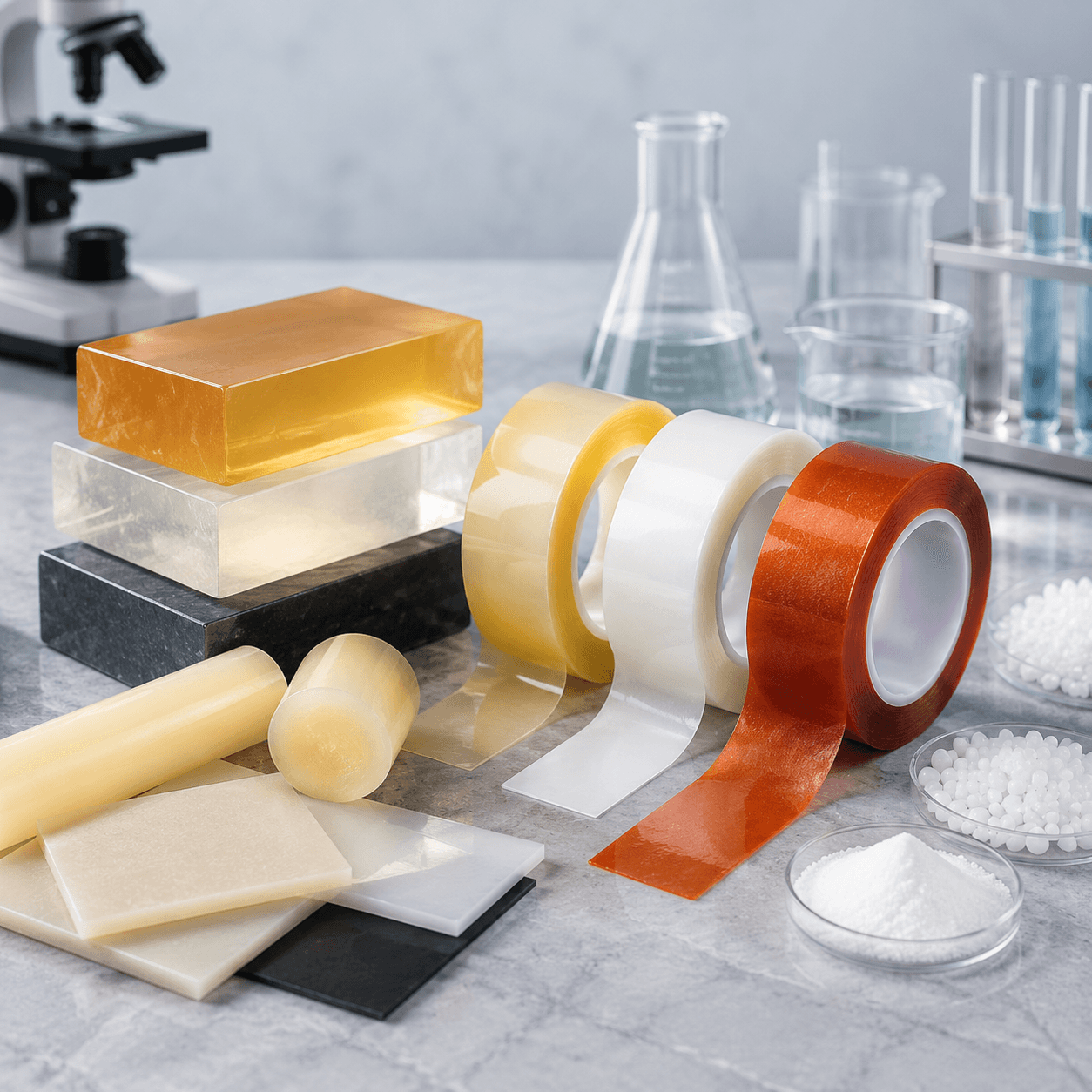
The backing or carrier usually gets first attention on a tape drawing, yet the pressure-sensitive adhesive (PSA) chemistry determines whether a part holds after a hot summer in transit, survives outdoor UV, or even wets out on molded polypropylene. Two rolls that look identical in width, color and thickness can behave completely differently on the line because one is coated with rubber and the other with acrylic.
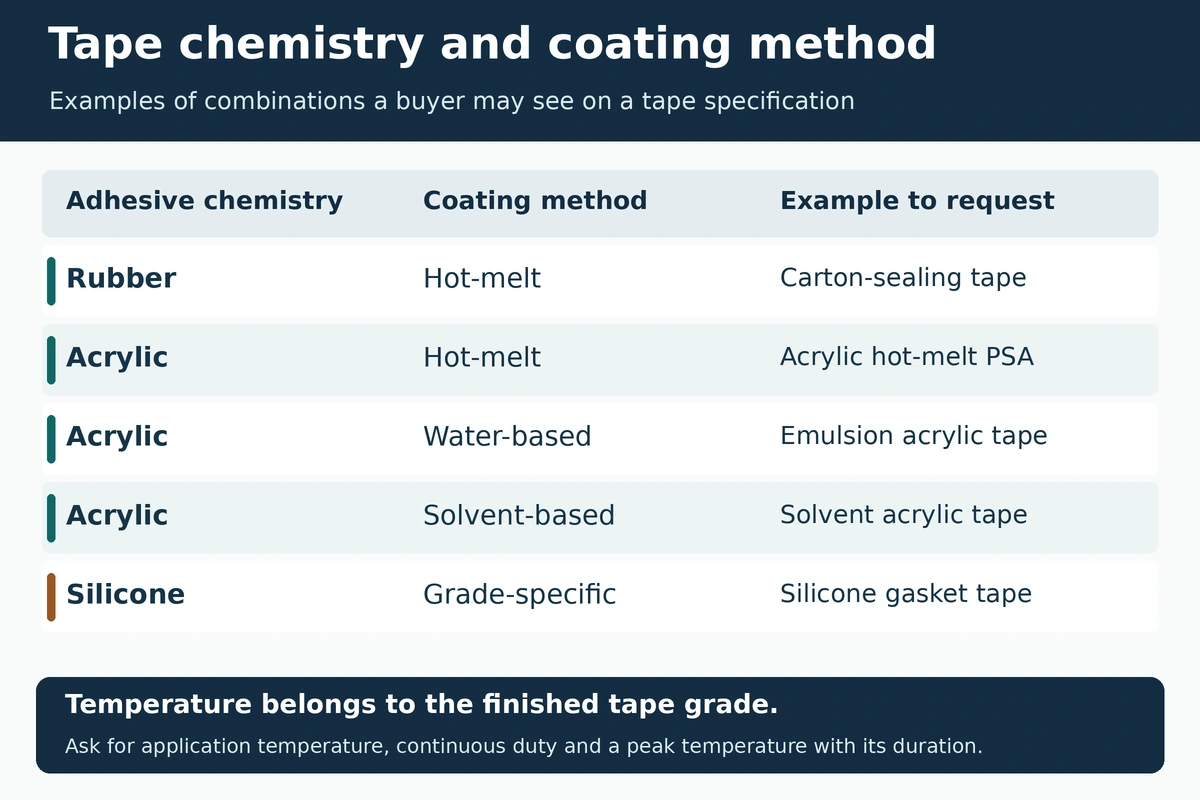
Acrylic, rubber and silicone describe adhesive chemistry. Hot-melt describes a coating process. In packaging, “hot-melt tape” commonly means rubber-based carton tape. Acrylic hot-melt pressure-sensitive adhesives are available too. Use the buyer’s terms to find a candidate, then ask the supplier to identify the polymer, the coating method and the finished tape grade. [R1] [R6]
Key takeaways
- Compare early handling and long-term holding separately. A rubber-based carton tape may grip recycled board promptly. An outdoor acrylic may give better weathering resistance on a panel. Measure those properties on the surface and under the load that matter to your order. [R1] [R3]
- Ask what “hot-melt” means on the quotation. A rubber hot-melt used on cartons and an acrylic hot-melt used on labels can share a coating method and behave differently in service. [R6]
- Specify the environment for an acrylic tape. A water-based emulsion and a solvent-coated acrylic can each be formulated for different exposure. Compare finished-tape moisture resistance, emissions data where relevant, and holding power under your load. [R3]
- Match silicone PSA to the application. A converter may use it on the silicone face of a gasket and use acrylic on the housing face. For a bake cycle, ask for the part temperature, exposure time and removal conditions supported by the exact tape. [R1]
- Primers do not “help either way”: Adhesion promoters are formulated for specific plastic-plus-adhesive pairings (most commonly acrylic PSAs on PP, PE or EPDM) and must be validated for flash-off time, appearance and stress cracking on real molded parts.
Quick comparison: acrylic vs. rubber vs. hot-melt vs. silicone
Read the first two columns together. The same polymer family can be coated in more than one way. The final column gives a practical trial for each example. For temperature, ask for the finished grade’s minimum application temperature, continuous service limit under the intended load, and short peak with an exposure time. [R1] [R3] [R6]
| Adhesive chemistry | Coating method or example | Early handling | Typical application | What to verify on the finished tape |
|---|---|---|---|---|
| Natural or synthetic rubber | Solvent-coated rubber is one example | Often gives fast initial grab | Indoor mounting or foam lamination | Peel on the actual surface and creep under the service load |
| Synthetic rubber | Hot-melt rubber packaging tape | Fast board grab is a selection target | Automated carton sealing | Flap lift on recycled board at packing and transit temperatures |
| Modified acrylic | Water-based, solvent-based or another grade-specific process | Tack and dwell vary with formulation | PP, PE or a powder-coated housing | Peel on the actual finish after the available dwell |
| Acrylic | Solvent, waterborne and acrylic hot-melt products are available | Measure early and aged peel | Outdoor labels, panels or nameplates | Weathering, sustained shear and peak time for the named grade |
| Silicone | Confirm process and backing with the supplier | Test the actual silicone or coated surface | Silicone gaskets or a specified masking cycle | Gasket-face peel or clean removal after the stated bake |
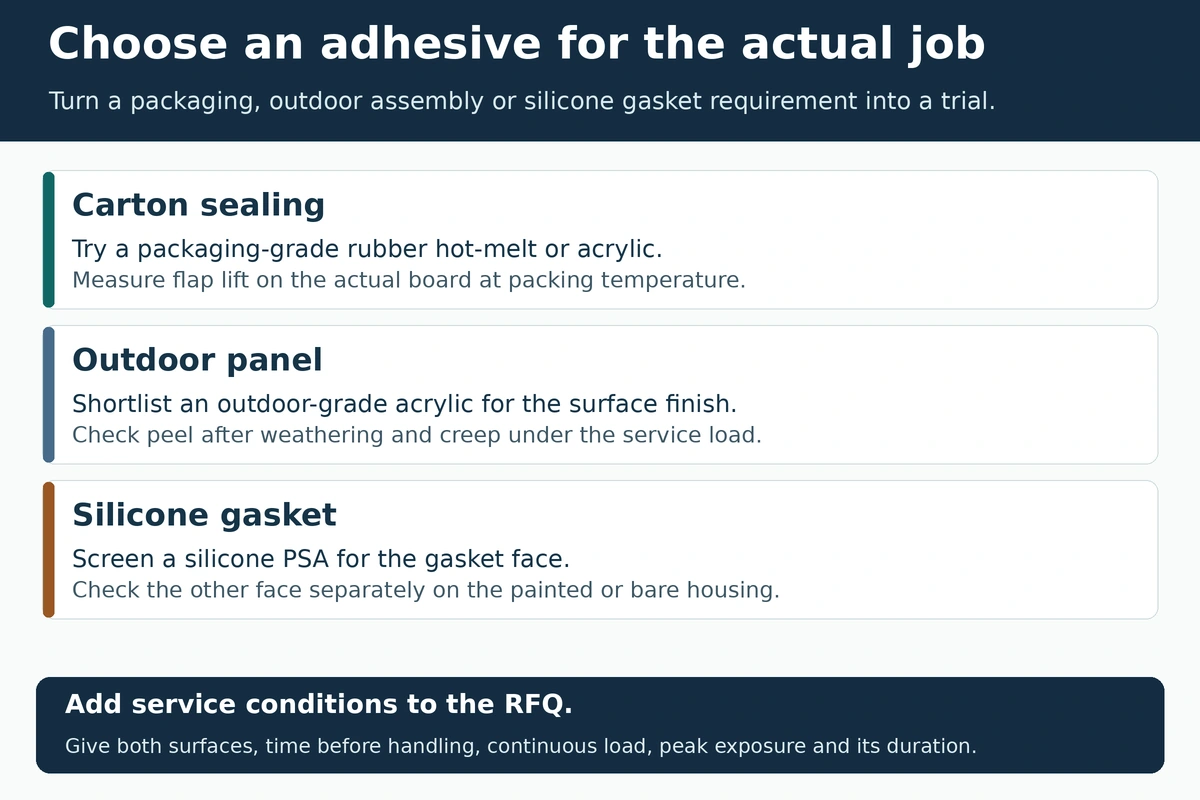
Start with the failure you want to prevent. On recycled cartons, look for flap lift in the minutes after sealing. On an outdoor panel, compare creep on the real finish at its measured surface temperature. For a silicone gasket, test each bonding face separately. If thickness or part movement drives the choice, use the double-sided tape carrier selection guide.
1. How pressure-sensitive adhesives bond—and why dwell time changes peel
According to the Pressure Sensitive Tape Council (PSTC) definition cited in 3M’s Science of Adhesion documentation, a true pressure-sensitive adhesive is defined by three properties: permanent tack, adhesion under light application pressure and no liquid-to-solid phase change [R1]. Unlike two-part epoxies or structural liquid acrylics, the adhesive on a tape roll is already fully polymerized when it leaves the coater. Bond strength develops through microscopic surface flow (wet-out), mechanical interlocking into surface micro-roughness and intermolecular attraction across the interface.
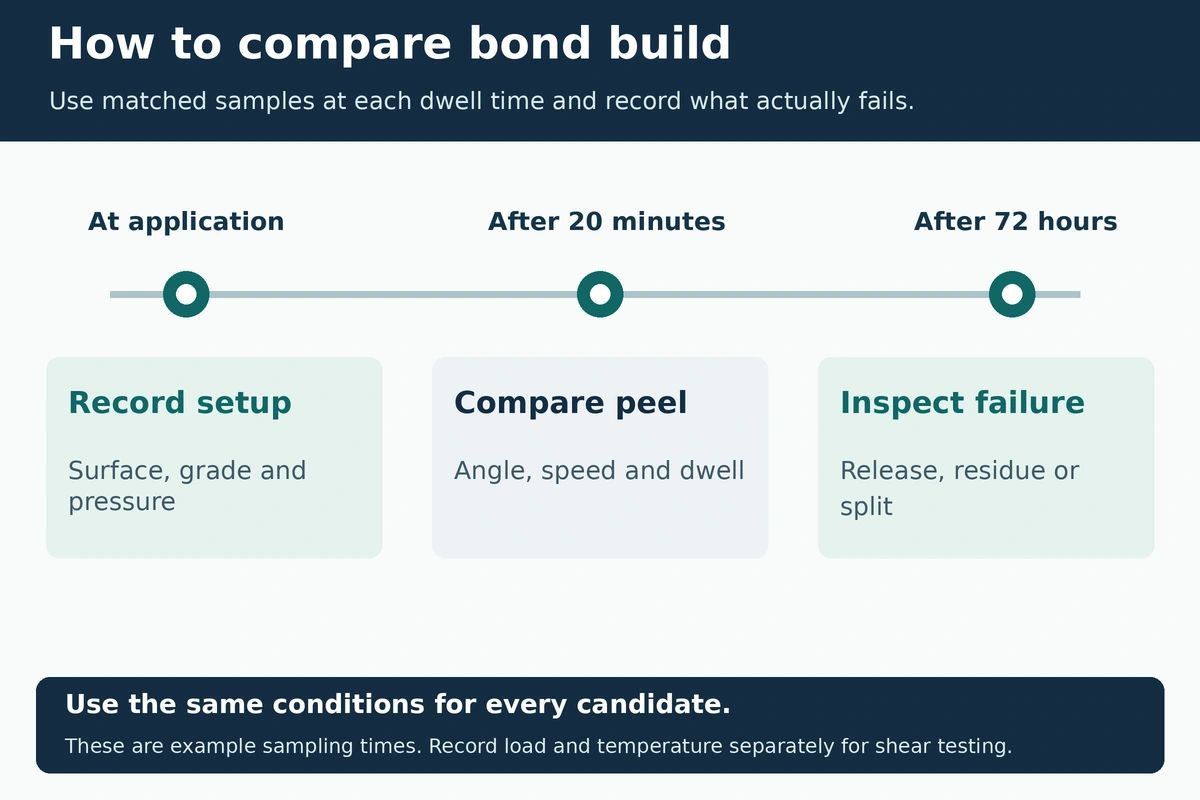
A thumb-tack check immediately after application can miss how peel develops on the actual substrate. For example, keep pressure, surface preparation and peel geometry constant and compare separate specimens after 20 minutes and 72 hours. Report the force and whether the interface released or the adhesive split. Test sustained shear separately under a defined load. [R1] [R4] [R5]
2. Adhesive families and the rubber hot-melt packaging example
Rubber adhesive (natural & solvent synthetic rubber): instant tack and economical versatility
Natural rubber (poly cis-isoprene) and solvent-coated synthetic elastomers (such as styrene-isoprene block copolymers) are blended with tackifying resins like pinene to create soft, aggressive PSAs [R1]. They wet out rapidly even on rough, slightly dusty or low-surface-energy substrates such as HDPE, LDPE, polypropylene and open-cell foams [R3].
- Where rubber wins: Indoor foam lamination (PE, EPDM, urethane foams), POP displays, indoor wire harnessing, paper/film splicing and temporary holding where quick stick and lower unit cost matter most.
- Distinguish grab from holding power. Avery Dennison’s portfolio includes both general-purpose and high-shear rubber formulations. Compare the candidate grade on its intended substrate at your service temperature. [R3]
- Qualify sunlight, heat and plasticizer exposure. A rubber grade that performs indoors can soften under load or lose adhesion after aging. Plasticized substrates add a migration risk. Where electrical ratings are required, check the finished tape in our PVC electrical tape guide.
Acrylic adhesive (pure vs. modified / LSE): durability, UV stability and engineered shear
Acrylic PSAs were engineered specifically to overcome natural rubber’s vulnerability to UV degradation, yellowing and thermal softening [R1]. Because the acrylic polymer backbone is saturated and inherently tacky without needing heavy oxidizable resin loads, acrylics offer the broadest mechanical and environmental tuning range in industrial tape converting—including clear double-sided tapes, structural foam tapes and double-sided tissue tapes.
- Pure and high-performance acrylics. These are candidates for weathering resistance, clarity and holding power on surfaces such as aluminum or glass. Use the named grade’s data sheet for its continuous load and temperature rating. Avery’s portfolio chart compares heat resistance within its own range. [R3]
- Modified acrylics for low-surface-energy parts. A tackified formulation can improve contact on PP, PE or a textured finish. Record peel, cohesive failure and hot creep on the actual finish. Additives and molding conditions can change the result. [R3]
- Plasticizer resistance caution: When bonding flexible PVC, vinyl trims or elastomer gaskets, verify plasticizer resistance on the TDS. Plasticizers migrate out of soft vinyl over months and can turn an unsuited acrylic adhesive into a soft, oozing gel.
Hot-melt rubber in automated carton sealing
Many hot-melt carton tapes use synthetic rubber such as an SIS or SBS block copolymer with a tackifier. The coater applies the blend molten. The delivered roll sticks under pressure. An acrylic hot-melt uses acrylic chemistry and can be crosslinked, as in BASF’s acResin range. The coating method alone tells a buyer very little about long-term holding power. [R6]
- Where to trial rubber hot-melt. Run the actual corrugated board on the production case sealer. Record flap spring-back, compression settings, line speed and whether the seal lifts before dispatch.
- Where to challenge the sample. Cold board at packing and a hot loaded carton in transit present different demands. Test the first for immediate grab and the second for creep. Request a freezer-grade product if the normal packing temperature calls for one.
Silicone PSA: extreme temperatures and silicone-to-silicone bonding
Silicone PSA is worth screening on a silicone gasket or a specified release surface. For masking, record the actual part temperature and time in the oven and check removal after cooling. For a permanent joint, ask separately for the continuous temperature and load supported by the construction. [R1] [R3]
- Critical boundary buyers often miss: Silicone PSA is not a universal “stronger LSE plastic glue.” As 3M’s PSA chemistry guide notes, silicone PSAs generally deliver lower ultimate mechanical strength and lower peel on ordinary non-silicone metals and plastics than acrylics, at a substantially higher material cost [R1].
- The differential tape solution: When you must mount a silicone rubber gasket or silicone sponge onto an aluminum enclosure or ABS housing, do not use a double-coated silicone-both-sides tape if the metal side sees shear load. Specify a differential double-coated PET tape—silicone PSA on the gasket side and high-shear acrylic PSA on the housing side.
Anatomy of a Differential Silicone / Acrylic Double-Coated Tape (Dissimilar-Substrate Assembly)
Face A — Silicone PSATrial this face on cured silicone gasket or sponge. Verify the assembly’s load and temperature rating.
Carrier — PET Film (e.g., 12–50 μm)Dimensional stability for clean rotary or flatbed die-cutting
Face B — Pure or LSE Acrylic PSAHigh shear & UV hold on aluminum, steel, PC, ABS or PP housing
Release Liner — Fluorosilicone / PET LinerPrevents silicone adhesive from locking onto a standard silicone liner
3. Solvent-based vs. water-based acrylic: choosing the right coating delivery
A quote described as “acrylic” leaves the coating method open. To compare offers, line up carrier, coat weight, roll dimensions, quantity, service requirements and the test behind each claim. Then ask whether each quoted grade is solvent-coated, emulsion-coated or hot-melt coated. [R3] [R6]
| Engineering Factor | Solvent-Based Acrylic | Water-Based (Emulsion) Acrylic | Rubber hot-melt packaging example |
|---|---|---|---|
| Polymer & Delivery | Acrylic polymer dissolved in organic solvent; oven-dried to a dense continuous film | Acrylic droplets dispersed in water using surfactants; dried to coalesce | Synthetic rubber blended with tackifier and coated molten for this packaging example |
| Water & Humidity Resistance | Ask for peel retention after the specified washdown or immersion. | Check the exact emulsion grade for whitening and loss of peel after exposure. | Test the finished tape on the printed or recycled board after humidity conditioning. |
| VOC, Odor & Cabin Standards | Requires thorough drying/testing for strict automotive interior VOC limits | Very low VOC & low odor — strong fit for vehicle cabins, appliances and indoor packaging | Zero coating solvent, though tackifier odor must be checked for enclosed cabins |
| Cold-Temp Application | Check the minimum application temperature on the finished grade. | Cold-room grades are available. Test early grab on chilled stock. | Test initial sealing on the coldest board the line will receive. |
| Typical Best Fit | Outdoor signage, automotive exterior trim, electronics gaskets, chemical exposure, heavy static shear | Carton sealing, cold-chain packaging, low-VOC cabin foams, indoor splicing, tissue & label converting | High-speed automated case sealers, recycled corrugated boxes, high-tack economical indoor bonding |
Converting note for die-cut parts: If your acrylic tape will be kiss-cut into narrow frames or small gaskets (see our custom die-cut adhesive pads design guide), ask your converter about edge ooze and cohesive firmness. Soft, heavily tackified or low-crosslink adhesives can bleed past cut edges during warm storage and weld adjacent parts back to the waste matrix.
4. Surface energy (HSE vs. LSE) and the real boundary for adhesion promoters
Even the highest-shear solvent acrylic cannot grip a surface it fails to wet out. Surface energy—measured in mJ/m2 (numerically equal to dynes/cm)—quantifies how strongly a substrate attracts liquid-like adhesive molecules across the bond line. Published reference groupings from the 3M Converter Markets Selection Guide illustrate why substrate naming matters far more than generic labels like “plastic” [R2]:
High Surface Energy (HSE)
Metals (450–1,100 mJ/m2): Copper (1,103), Aluminum (840), Stainless Steel (700–1,100), Zinc (753).
Glass & High-Energy Polymers (42–500): Glass/Porcelain (250–500), Polyimide (50), Nylon (46), Polyester/PET (43), ABS (42), Polycarbonate (42).
Medium / Transition Range
38–43 mJ/m2: Rigid PVC (39), Acrylic/PMMA (38), Modified PPE (38), Epoxy & Polyurethane paints (43).
Caution: Paint additives, silicone slip agents and matte textures can drop an apparently “medium” coated metal well into LSE behavior.
Low Surface Energy (LSE)
≤37 mJ/m2: Polystyrene (36), Acetal (36), EVA (33), Polyethylene / PE (31), Polypropylene / PP (29), PVF (28), PTFE (18), plus many powder-coated paints.
Standard pure acrylic beads up on these surfaces; specify rubber, modified LSE acrylic or validated surface preparation.
Correcting a common myth — “A primer helps either way” is false:
Adhesion promoters (tape primers) are not universal boosters that improve every adhesive on every plastic. Most commercial tape primers are designed to bridge specific LSE plastics (such as PP, PE, TPO or EPDM) to specific acrylic adhesive systems; applying an incompatible primer under a rubber adhesive, including a hot-melt rubber can weaken the interface, soften the adhesive or leave a weak boundary layer if applied too thick or taped before full flash-off. Primers also add labor, VOC handling, shelf-life control and possible hazing or stress-cracking risk on sensitive plastics like polycarbonate or ABS. Always test an LSE-formulated adhesive first, and only introduce a primer after validating the exact substrate-primer-tape combination on real molded parts. For a full A/B/C trial protocol on polyolefins, see our guide on why tape won’t stick to PP or PE plastic.
5. Worked selection scenarios, roll consumption math and incoming QC tests
To show how chemistry selection translates into real purchasing decisions, consider a manufacturer sourcing tapes for two lines in the same facility: an outdoor HVAC control enclosure line and a high-volume shipping line.
Scenario A: Outdoor Aluminum Nameplate on Powder-Coated Cabinet
Conditions: 20,000 units/year; brushed aluminum nameplate (80 mm × 40 mm) bonded to textured polyester powder-coated steel; summer cabinet skin reaches 70 °C under full UV sun; 5-year service expectation.
Failure to screen for. A high initial peel reading taken indoors cannot predict creep on a sun-heated cabinet. Hold a representative panel under its actual load at the recorded 70 °C surface temperature and inspect the edges after weathering.
Shortlist. Compare an outdoor-rated acrylic intended for the actual powder coating with a second candidate. Ask for its continuous temperature under load. Include a 72-hour dwell check and a loaded 70 °C trial for this particular cabinet.
Scenario B: Automated Corrugated Carton Sealing Line
Conditions: 50,000 export cartons/quarter (length 500 mm, top and bottom center seams with 75 mm leg overlap on each end); recycled Kraft board with stiff flaps; automatic case sealer at 28 boxes/min; ambient 18–30 °C warehouse.
Handling window. A formulation that builds useful peel only after a long dwell may let a springy flap lift at the compression rollers. Check the seal as it exits the actual machine.
Shortlist. Try a rubber hot-melt carton tape alongside a packaging acrylic on the same board. If cartons enter cold storage, include one grade with a documented application temperature suitable for the actual board temperature.
Worked roll purchasing math (Scenario B)
Calculate exact tape footage before requesting pricing so suppliers quote the right master-roll and case quantities:
- Tape per carton (H-free center seam, top + bottom): Each seam needs box length (500 mm) + two 75 mm end tabs = 650 mm; top + bottom = 1,300 mm = 1.30 m/carton.
- Net tape for 50,000 cartons: 50,000 × 1.30 m = 65,000 m.
- Standard machine-length rolls (914 m / 1,000 yd per roll) vs. hand rolls (66 m): On an automated line using 914 m machine rolls, net demand is 65,000 / 914 = 71.1 rolls. Adding a realistic 6% changeover, splice and leader allowance gives 71.1 × 1.06 = 75.4 → 76 machine rolls (19 cartons at 4 rolls/case). On hand-dispenser 66 m rolls, the same run takes 65,000 / 66 = 985 net rolls, or 1,044 whole rolls with 6% waste—highlighting why machine-length rolls cut both core waste and line downtime.
Four practical incoming QC checks before releasing bulk production
Do not rely on a generic “high tack” brochure claim. Specify measurable test methods aligned with ASTM D3330 and ASTM D3654 on your approval sheet [R4] [R5]:
| Incoming Check | Reference Method | What to Verify on Samples | Failure Mode Caught Early |
|---|---|---|---|
| 1. Peel at 20 min vs. 72 h dwell | ASTM D3330 (90° or 180° peel) [R4] | Compare steel baseline AND your actual substrate after 20 min and 72 h dwell; record whether failure is adhesive (clean peel) or cohesive (split residue) | Prevents rejecting acrylic prematurely and exposes poor wetting on molded LSE plastics or release-agent residue |
| 2. Static shear at service temperature | ASTM D3654 holding power [R5] | Apply a defined load at the actual continuous service temperature. Record bond area, load, exposure time and measured creep. Test a short peak separately. | Distinguishes slip under a sustained load from survival of a brief heat excursion. |
| 3. Aging / UV / humidity conditioning | Internal environmental soak (e.g., 7–14 days heat/humidity or UV exposure) | Re-test peel and check for yellowing, edge lifting, adhesive bleeding or substrate staining | Catches rubber UV hardening, water-based acrylic whitening in wet service, or PVC plasticizer migration |
| 4. Unwind, liner release & edge ooze | Line trial on actual dispenser or die-cut press | Confirm consistent unwind tension, clean liner separation without adhesive transfer, and zero sticky roll sides | Prevents machine jams, telescoping rolls and die-cut matrix tearing |
6. Copy-ready tape adhesive RFQ template
Sending a structured 8-line specification eliminates guesswork and lets an engineering supplier recommend the right adhesive family, coat weight and carrier on the first sample round:
Subject: Tape Adhesive Specification & Evaluation Roll Request — [Project / Part Name]
- Substrate A (exact material & finish): [e.g., Brushed 5052 aluminum / Uncoated PP / Recycled kraft carton]
- Substrate B (exact material & finish): [e.g., Textured polyester powder-coated steel / EPDM foam / Cured silicone]
- Application and service temperatures: [Part at bonding __ °C]. Service range: [Min __ °C to Max continuous __ °C; short peak __ °C for __ min]
- Environment & service life: [Indoor / Outdoor UV / Wet washdown / Automotive cabin low-VOC; target __ years]
- Load & handling requirement: [Instant automated grab vs. 24–72 h dwell acceptable; peel vs. static shear load __ g/cm²]
Proposed tape grade, chemistry, coating method and coat weight: [supplier to complete] - Removability & appearance: [Permanent / Clean removable after __ days / Optically clear non-yellowing]
- Format & converting: [Single-sided / Double-sided (carrier preference) / Transfer tape / Die-cut pads; width __ mm × length __ m]
- Compliance & trial volume: [RoHS / REACH / Low-VOC / UL; trial roll count __; estimated annual volume __ rolls or pcs]
Frequently asked questions
Which adhesive sticks best immediately — rubber, hot-melt or acrylic?
For fast carton handling, a rubber hot-melt is a sensible first trial. Compare immediate flap lift on the same board with a suitable packaging acrylic, at the same temperature, pressure and line speed. If the application also carries load, evaluate holding power after the available dwell. [R1]
Rubber vs. acrylic adhesive: which is better for outdoors and heat?
For outdoor panels, shortlist grades with documented weathering resistance, often acrylics. Ask the supplier for separate continuous-load and short-peak limits with durations. A brief masking bake and years under load are different buying specifications. Use a named product’s technical data and verify its performance on the actual finish. [R1] [R3]
Should I choose rubber or acrylic for polypropylene (PP) and polyethylene (PE)?
For PP or PE, request a candidate formulated for the actual mold finish. Rubber may suit quick indoor handling. An LSE acrylic is worth screening where weathering or sustained load matters. Test the unprimed part first and add a matched primer only when the comparison shows a benefit without surface damage. [R2]
When should I pick hot-melt vs. acrylic packaging tape?
A packaging-grade rubber hot-melt often provides quick grab on recycled board. Compare it with a packaging acrylic on the same carton at line speed. If cartons will be packed cold, stored for a long time or shipped through a hot container, reproduce that sequence in the trial. Ask for the maximum acceptable flap lift and agree on the inspection time.
What is the difference between solvent-based and water-based acrylic tape adhesive?
Solvent-coated acrylic uses organic solvent as its delivery medium. An emulsion uses water as the principal carrier during coating. Compare the finished grades for emissions, moisture resistance and shear under the expected load. Those outcomes also depend on the formulation and coat weight.
Can silicone adhesive tape bond regular plastics and metals?
Silicone PSA is a useful candidate for silicone rubber. On ordinary plastic or metal, compare peel and shear with a suitable acrylic. When the two mating surfaces differ, a converter can supply a differential construction with silicone PSA on the gasket face and acrylic on the housing face. Verify both interfaces in the finished joint. [R1]
Technical Resources
- 3M — Science of Adhesion: Common Chemistry of PSA Tapes. Overview of pressure-sensitive rubber, silicone and acrylic formulations and typical application considerations.
- 3M — Converter Markets Selection Guide (January 2026 edition). Reference surface energy values (mJ/m2) for metals, HSE plastics and LSE plastics (PP 29, PE 31, PTFE 18) plus pressure-sensitive tape construction diagrams.
- Avery Dennison Performance Tapes — Core Series Portfolio Product Selection Tool. Page 8 compares the heat resistance of selected Core Series products. Check the finished grade’s data sheet for an application-specific operating limit.
- ASTM International — D3330/D3330M, Peel Adhesion of Pressure-Sensitive Tape. Current catalog edition D3330/D3330M-04(2025). Record the peel method, surface and dwell for comparable results.
- ASTM International — ASTM D3654 / D3654M Standard Test Methods for Shear Adhesion of Pressure-Sensitive Tapes. Standard holding-power methods for evaluating static shear resistance under constant parallel load and elevated temperature (public summary reviewed).
- BASF — acResin acrylic hot-melt polymers. Product-family example of acrylic hot-melt chemistry for pressure-sensitive labels and tapes.
These references document industry test standards and specific named manufacturers’ benchmark envelopes. They do not imply brand endorsement, establish equivalence to a nibaL product, or substitute for qualifying trial rolls against your own parts and applicable Technical Data Sheets.
ABOUT NIBAL TAPE
Match the Right Tape Adhesive to Your Substrates
nibaL Tape supplies and converts custom double-sided tapes, clear acrylic tapes, tissue tapes, PVC electrical tapes and custom die-cut adhesive parts. Learn more about nibaL.
Send both substrate materials, service temperature, indoor/outdoor exposure, roll dimensions and target volumes so our team can recommend matched adhesive constructions and prepare evaluation rolls for your 20-minute and 72-hour qualification tests.